Every child is an artist. The Problem is how to remain an artist once (s)he grows up. --Pablo Picasso
Continuing from the last few posts:
What about the relationship between a observation and analysis -- the space between sight and insight -- demands attention for successful business practice?
Executives are not the only ones who are challenged by sustainable innovation in this way. After all, executives -- and their business habits -- come from their work as employees.
So where do employees come from? And how do they end up in that Box so many bosses complain about?
In addition to need for and challenges of sustaining curiosity and understanding the value of need for and conflict, it's also essential to build sustainable disciplines for practices of observation and analysis.
Like the complete group of practices with which it combines for sustainable creativity in business, insight is only possible by understanding from the beginning that you don't know the answer. It also requires balance, focus, practice, and persistence.
Here's a case study to further illustrate the point.
Background: Learning a Credible Pitch
Fifteen participants gathered for a course in self-presentation. Each brought to the class more streets smarts than formal training.
The Set Up
One by one each participant made a pitch for a new perspective on an idea or product. Each story was prepared beforehand, and each lasted about five minutes.
The Challenge
It quickly became apparent that the participants were struggling to discover a physical gesture to support the meaning of their words. Each participant looked for body language that would put across a genuine investment, connection, and belief in what they were saying. None succeed in finding a way of moving, standing, or emphasizing points that seemed naturally connected to the story.
Even the Smoothest Talkers Go Blank
Remember, all of the participants had given very effective pitches before. But in this classroom, they seemed to search for gestures out of the air, as though they had never done this before.
Why?
The problem was that none of the participants had consciously observed and noted their own past presentations. Put in new circumstances, they felt lost.
None had focused on process in past pitches. Because they had all concentrated only on results, they couldn't transfer the skills that were strong in familiar environments and with familiar subject matter.
Without the usual cues in familiar contexts, they all went blank.
More on this in the next post.
Monday, February 27, 2006


Monday, February 20, 2006
Executive Challenges: Between Sight and Insight
To help illustrate the importance for business practice of mastering a relationship between observation and anaylsis, it might be helpful to see how it plays out for executives.
Business Ethnography as a Case in Point
The following article was the result of a discussion with an advertising executive who had strong objections to the way in which professionals conduct research and present results in her field. We worked together to articulate the commons issues among her specific field and effective thinking across contexts.
Sight Before Insight
For good and ill, business ethnography has come to represent the broadest category of research on film. Technological improvements in cameras have made data collection easy and inexpensive, and clients can find out first-hand almost an unlimited number of details of consumer behavior.
How much more reliable is observation than the results of a questionnaire? Rather than speculating about what a subject would do from the distance of a focus group, a person can show you, up close and personal, in the more applicable setting of her own home. You’ve seen this sort of research at presentations – agencies can collect an unlimited and disparate variety of data and create a link with the client’s product.
The question is: even though data has been captured on film, how do you know what it means?
The ease of contemporary filming may have made us excellent reporters but has not inherently improved our ability to analyse. The question here is the same as with all technology – how can we use what we know to improve our understanding?
Case Study: Casual Eating
The challenges to the advertising industry are apparent in a film recently shown at a conference for an international foods client.
The film consisted of a series of clips, each presenting a subject discussing with an interviewer reactions to food being eaten as the conversation took place. The format was question and answer and focused both on expectations and the actual eating experience at hand. Subjects were presented in mid-shot with suggestions of their environment behind them – the edge of a kitchen cabinet, a bedroom window curtain, the corner of a rug. However, the frame was otherwise entirely filled with the subject’s face.
Because the reporting was done on film, the result was more far more entertaining and engaging than it would have been on paper. Subjects’ opinions were clearly presented, and the tape offered a variety of responses to the food that seemed to represent a wide range both of opinion and impression – in other words, some liked the flavor, some were more interested in texture, some were more interested in the way it made them feel, and so on.
The presenter concluded with a summary of the results already seen, a mention of the target audience, and an announcement of her key insight.
There were two problems here. The first is that the summary and the key insight were the same. The second is that nobody seemed to notice.
This is not unusual. The immediacy of an film audience’s experience and the presumed transparency between the medium and the detail it captures can make us forgetful of the necessity to reflect. However, we need to remember that the act of seeing (observation) is not the same as the tool of insight (meaning).
And because we all agree that even the most meticulous observation can not replace analysis, here are some questions to consider when determining whether your video presents enough information on which to inform strategy:
How many people from different contexts can be made a part of the editing process?
• Can you include someone with entirely fresh eyes? A planner? A client? Can you put them in the same room? An industry expert?
• Can you generate analysis in stages – during the pre-production, filming, and post-production?
What is the difference between action and motivation?
• How will you determine why a subject does what they do other than by what she says?
• How much time is spent observing and how much interacting in the film? What does a subject tell you, what does the environment tell you, and do they agree?
• What evidence can you find of motivation in a subject’s home environment?
• What clues either corroborate or contradict what the subject says? Will the subject acknowledge inconsistencies? Why or why not? How do you know?
This is not to say that ethnography is the only effective use of video research. After all, observation and interrogation are necessary for any research --you can’t get the insight you’re after without accurate data. Ethnography comes in when we need to draw conclusions form that data.
The most important thing is not to mistake one for the other.
Business Ethnography as a Case in Point
The following article was the result of a discussion with an advertising executive who had strong objections to the way in which professionals conduct research and present results in her field. We worked together to articulate the commons issues among her specific field and effective thinking across contexts.
Sight Before Insight
For good and ill, business ethnography has come to represent the broadest category of research on film. Technological improvements in cameras have made data collection easy and inexpensive, and clients can find out first-hand almost an unlimited number of details of consumer behavior.
How much more reliable is observation than the results of a questionnaire? Rather than speculating about what a subject would do from the distance of a focus group, a person can show you, up close and personal, in the more applicable setting of her own home. You’ve seen this sort of research at presentations – agencies can collect an unlimited and disparate variety of data and create a link with the client’s product.
The question is: even though data has been captured on film, how do you know what it means?
The ease of contemporary filming may have made us excellent reporters but has not inherently improved our ability to analyse. The question here is the same as with all technology – how can we use what we know to improve our understanding?
Case Study: Casual Eating
The challenges to the advertising industry are apparent in a film recently shown at a conference for an international foods client.
The film consisted of a series of clips, each presenting a subject discussing with an interviewer reactions to food being eaten as the conversation took place. The format was question and answer and focused both on expectations and the actual eating experience at hand. Subjects were presented in mid-shot with suggestions of their environment behind them – the edge of a kitchen cabinet, a bedroom window curtain, the corner of a rug. However, the frame was otherwise entirely filled with the subject’s face.
Because the reporting was done on film, the result was more far more entertaining and engaging than it would have been on paper. Subjects’ opinions were clearly presented, and the tape offered a variety of responses to the food that seemed to represent a wide range both of opinion and impression – in other words, some liked the flavor, some were more interested in texture, some were more interested in the way it made them feel, and so on.
The presenter concluded with a summary of the results already seen, a mention of the target audience, and an announcement of her key insight.
There were two problems here. The first is that the summary and the key insight were the same. The second is that nobody seemed to notice.
This is not unusual. The immediacy of an film audience’s experience and the presumed transparency between the medium and the detail it captures can make us forgetful of the necessity to reflect. However, we need to remember that the act of seeing (observation) is not the same as the tool of insight (meaning).
And because we all agree that even the most meticulous observation can not replace analysis, here are some questions to consider when determining whether your video presents enough information on which to inform strategy:
How many people from different contexts can be made a part of the editing process?
• Can you include someone with entirely fresh eyes? A planner? A client? Can you put them in the same room? An industry expert?
• Can you generate analysis in stages – during the pre-production, filming, and post-production?
What is the difference between action and motivation?
• How will you determine why a subject does what they do other than by what she says?
• How much time is spent observing and how much interacting in the film? What does a subject tell you, what does the environment tell you, and do they agree?
• What evidence can you find of motivation in a subject’s home environment?
• What clues either corroborate or contradict what the subject says? Will the subject acknowledge inconsistencies? Why or why not? How do you know?
This is not to say that ethnography is the only effective use of video research. After all, observation and interrogation are necessary for any research --you can’t get the insight you’re after without accurate data. Ethnography comes in when we need to draw conclusions form that data.
The most important thing is not to mistake one for the other.
Monday, February 13, 2006
Toward Sustainable Innovation: Observation vs. Analysis 2
Learning How to See. Again.
Unfortunately, the pressure to perform has allowed us at best, to confuse the processes of observation and analysis, and at worst, to skip the process of observation entirely.
In order to develop new ideas, the first step is to really see what's in front of you. In order to do that, you need to remember how to look.
What Have Adults Forgotten?
Curiosity is hard-wired from birth. This drives a process of experiment and discovery that explains the reason you see your toddler throwing cutlery from a high-chair -- just to see what happens. Maybe a cup will make a different sound? Maybe a cup with water would be fun to watch fly? If children like the results -- and often they do -- they'll repeat the performance just for the pleasure of observing the results.
Then Comes Education
The shift comes when a child is asked to replace his or her own investment in what's important with that of an adult. What we have come to call education focuses almost entirely on results.
Observation: The First Step Toward Insight
The process of observation is essential to analysis, and ultimately insight. However, it is a process that, if taught at all, is not valued nearly as much as the results it produces.
Parents prepare children for school from infancy by asking for particular behavior. A consistent demand for a particular results trains small people to offer up what pleases someone else rather than themselves.
The way of thinking creates a habit of believing the answer exists outside oneself and trying to find it in the expectations of someone else.
However, before finding an answer independently, you have to examine the data. This requires an engagement in the material that is entirely one's own.
What Gets in the Way?
If you're taught from infancy to find the answer someone else wants, you'll look for answers in their expectations rather engaging in the data with which you are presented. The pressure for results probably won't help either. Observation requires the time it takes to really look and absorb what you see.
If this all sounds obvious, it's not. Most people I've worked with -- from young students to executives -- confuse the process of observation and analysis. In fact, people tend to skip the former in part or entirely.
Children in School Become Adults at Work
In adulthood, this problem can serve as the foundation for The (dreaded)Box. Both believing an answer exists outside of one and the urgent demand for results probably won't produce anything new. As a process, it certainly isn't sustainable.
An advertising executive came to me asking questions about the reasons her staff and highly regarded professionals in her field couldn't seem to distinguish data from the conclusions they draw from them. We dubbed this the space between sight and insight -- see the article in the next post.
One caveat
Please do not mistake this call for change in perspective on educational perspective as an invective against school per se. Walden is not my model. I wouldn't have bothered getting a PhD if it were.
Whether or not they go on to higher education, children need adults to model, teach, and broaden their perspectives, and school can be great. As long as it cultivates, rather than dismisses, children's engagement and interests.
Unfortunately, the pressure to perform has allowed us at best, to confuse the processes of observation and analysis, and at worst, to skip the process of observation entirely.
In order to develop new ideas, the first step is to really see what's in front of you. In order to do that, you need to remember how to look.
What Have Adults Forgotten?
Curiosity is hard-wired from birth. This drives a process of experiment and discovery that explains the reason you see your toddler throwing cutlery from a high-chair -- just to see what happens. Maybe a cup will make a different sound? Maybe a cup with water would be fun to watch fly? If children like the results -- and often they do -- they'll repeat the performance just for the pleasure of observing the results.
Then Comes Education
The shift comes when a child is asked to replace his or her own investment in what's important with that of an adult. What we have come to call education focuses almost entirely on results.
Observation: The First Step Toward Insight
The process of observation is essential to analysis, and ultimately insight. However, it is a process that, if taught at all, is not valued nearly as much as the results it produces.
Parents prepare children for school from infancy by asking for particular behavior. A consistent demand for a particular results trains small people to offer up what pleases someone else rather than themselves.
The way of thinking creates a habit of believing the answer exists outside oneself and trying to find it in the expectations of someone else.
However, before finding an answer independently, you have to examine the data. This requires an engagement in the material that is entirely one's own.
What Gets in the Way?
If you're taught from infancy to find the answer someone else wants, you'll look for answers in their expectations rather engaging in the data with which you are presented. The pressure for results probably won't help either. Observation requires the time it takes to really look and absorb what you see.
If this all sounds obvious, it's not. Most people I've worked with -- from young students to executives -- confuse the process of observation and analysis. In fact, people tend to skip the former in part or entirely.
Children in School Become Adults at Work
In adulthood, this problem can serve as the foundation for The (dreaded)Box. Both believing an answer exists outside of one and the urgent demand for results probably won't produce anything new. As a process, it certainly isn't sustainable.
An advertising executive came to me asking questions about the reasons her staff and highly regarded professionals in her field couldn't seem to distinguish data from the conclusions they draw from them. We dubbed this the space between sight and insight -- see the article in the next post.
One caveat
Please do not mistake this call for change in perspective on educational perspective as an invective against school per se. Walden is not my model. I wouldn't have bothered getting a PhD if it were.
Whether or not they go on to higher education, children need adults to model, teach, and broaden their perspectives, and school can be great. As long as it cultivates, rather than dismisses, children's engagement and interests.
Wednesday, February 08, 2006
Observation and Analysis, Part 1: Summing Up Where We've Been to Get to Where We're Going
Creativity: Too Woo Woo for Work?
In the most mundane sense, creativity allows us to live our lives with more satisfaction by finding new ways of seeing. It makes problems easier to solve and life more fun.
Nothing like it for making money, either, as many CEOs have told me over the past three years. But its not the result of a mysterious intangible process. It's the ability to learn continously across contexts.
Curiosity: Something to be Cultivated
Curiosity, particularly when sustained, can certainly drive innovation because it's a short cut to genuine engagement. Genuine engagement can drive anyone to persistent investigation. Investigation, when supported by appropriate skills, will eventually lead to new thinking.
Observation and Analysis: A Big Challenge But Not Mysterious
Even without initial personal investment in a problem, good results can be got in an ongoing dialogue between observation and analysis. In short, this constitutes a discipline of looking, sorting through, and identifying meaning even in unfamiliar circumstances. A lot of it is simply grunt work.
The only mystical thing about this process is its results. It's always quite amazing to find possibilities where there once seemed to be none.
An Advantage of the Human Brain
Because thinking is associative, it seems we as human beings are hard-wired to make connections.
The trick is to continually be open to discovery and to release or add new ideas as they arise. It's a balance of retaining ideas and yet being supple and flexible enough to experiment not just with new information but with new processes of exploring what we already know.
The First Step: Pretend You Don't Know the Answer (Because You Don't)
One key to developing innovative technique is exploring the relationship between innovation and analysis. Let's start with observation.
Show up to a problem assuming that you don't know the answer -- because if you want to come up with a new possibility, you don't.
Don't Even Look for Answers -- Yet
The pressure to produce, the knowledge that your results will be measured, and other forms of performance anxiety need to be left aside for this process.
As much as possible, come to a project with fresh eyes. See the information new. Observation requires the discipline of consistent exploration. When you stay in a rut using one set of practices, find others. There are many techniques for doing this -- one is to cross disciplines. Others are available as well (just ask a good consultant or your favorite teacher).
The Scary Part
Before setting out on the journey for new ideas, accept that learning is disorganizing. Don't just give it lip service -- know it in your bones.
Feeling lost is part of the process. Once you've done it a few times and got good results, you'll understand why the discomfort is worth it. You might even get used to it.
A Different Way of Thinking
Because we as human beings become split to fulfill the seemingly persistent short-term needs of the workplace, we reserve a piece of ourselves for the tasks at hand and save the rest for our families, hobbies. It's the way most people survive every day catering to someone else's needs.
Because thinking is associative, the more of our own resources we've got to work with, the better for innovation. Also, the disciplines, interests, ideas in which we feel genuine ownership are more likely to engage us. The more engaged, the less we worry about the answer, the more we explore.
Some Strategies
One way to do this is to identify and hold onto what engages you. Explore, investigate, immerse yourself, even if it has nothing to do with work.
Once you've come to the end of your interests, find more.
Remember once a day what it feels like to be yourself in that state while in the office. Maintain as much of a connection internally between the pieces of your identity outside and inside the office. Then when it comes to solving problems in the office, you'll have a point of reference that's broader than the narrow parameters in which you usually operate.
Or -- find something you know nothing about -- or a topic that seems to have nothing to do with the problem at hand. Put the ideas side-by-side with the data set from the work day, and explore the connections.
The point is -- in order to see things new, you need to explore connections for their own sake.
At least, at first.
More on honing the process of Observation and Analysis in the next series of posts.
In the most mundane sense, creativity allows us to live our lives with more satisfaction by finding new ways of seeing. It makes problems easier to solve and life more fun.
Nothing like it for making money, either, as many CEOs have told me over the past three years. But its not the result of a mysterious intangible process. It's the ability to learn continously across contexts.
Curiosity: Something to be Cultivated
Curiosity, particularly when sustained, can certainly drive innovation because it's a short cut to genuine engagement. Genuine engagement can drive anyone to persistent investigation. Investigation, when supported by appropriate skills, will eventually lead to new thinking.
Observation and Analysis: A Big Challenge But Not Mysterious
Even without initial personal investment in a problem, good results can be got in an ongoing dialogue between observation and analysis. In short, this constitutes a discipline of looking, sorting through, and identifying meaning even in unfamiliar circumstances. A lot of it is simply grunt work.
The only mystical thing about this process is its results. It's always quite amazing to find possibilities where there once seemed to be none.
An Advantage of the Human Brain
Because thinking is associative, it seems we as human beings are hard-wired to make connections.
The trick is to continually be open to discovery and to release or add new ideas as they arise. It's a balance of retaining ideas and yet being supple and flexible enough to experiment not just with new information but with new processes of exploring what we already know.
The First Step: Pretend You Don't Know the Answer (Because You Don't)
One key to developing innovative technique is exploring the relationship between innovation and analysis. Let's start with observation.
Show up to a problem assuming that you don't know the answer -- because if you want to come up with a new possibility, you don't.
Don't Even Look for Answers -- Yet
The pressure to produce, the knowledge that your results will be measured, and other forms of performance anxiety need to be left aside for this process.
As much as possible, come to a project with fresh eyes. See the information new. Observation requires the discipline of consistent exploration. When you stay in a rut using one set of practices, find others. There are many techniques for doing this -- one is to cross disciplines. Others are available as well (just ask a good consultant or your favorite teacher).
The Scary Part
Before setting out on the journey for new ideas, accept that learning is disorganizing. Don't just give it lip service -- know it in your bones.
Feeling lost is part of the process. Once you've done it a few times and got good results, you'll understand why the discomfort is worth it. You might even get used to it.
A Different Way of Thinking
Because we as human beings become split to fulfill the seemingly persistent short-term needs of the workplace, we reserve a piece of ourselves for the tasks at hand and save the rest for our families, hobbies. It's the way most people survive every day catering to someone else's needs.
Because thinking is associative, the more of our own resources we've got to work with, the better for innovation. Also, the disciplines, interests, ideas in which we feel genuine ownership are more likely to engage us. The more engaged, the less we worry about the answer, the more we explore.
Some Strategies
One way to do this is to identify and hold onto what engages you. Explore, investigate, immerse yourself, even if it has nothing to do with work.
Once you've come to the end of your interests, find more.
Remember once a day what it feels like to be yourself in that state while in the office. Maintain as much of a connection internally between the pieces of your identity outside and inside the office. Then when it comes to solving problems in the office, you'll have a point of reference that's broader than the narrow parameters in which you usually operate.
Or -- find something you know nothing about -- or a topic that seems to have nothing to do with the problem at hand. Put the ideas side-by-side with the data set from the work day, and explore the connections.
The point is -- in order to see things new, you need to explore connections for their own sake.
At least, at first.
More on honing the process of Observation and Analysis in the next series of posts.
Monday, February 06, 2006
Shamelessly Off Topic: For Those With Children (or Who Just Like a Good Story)
I am very happy to announce that Ron Barrett (Cloudy With a Chance of Meatballs, Old MacDonald Had An Apartment House, Animals Should Definitely Not Wear Clothing) kindly contributed a picture to It's a Drag to Be a Dragon.
Frankly, it's an honor.
The new picture is certainly worth checking out, as is the drawing for the King Arthur tail.
These stories -- even without the images -- are parent tested, child approved. You can try this at home.
Last, if you don't have all of Ron's books yet, it's worth a trip to Barnes and Noble. But first see if you like what you get here for free.
Frankly, it's an honor.
The new picture is certainly worth checking out, as is the drawing for the King Arthur tail.
These stories -- even without the images -- are parent tested, child approved. You can try this at home.
Last, if you don't have all of Ron's books yet, it's worth a trip to Barnes and Noble. But first see if you like what you get here for free.
Monday, January 30, 2006
Strategies for Sustainable Curiosity: Part 2
If you missed last week's adventure into the wilds of curiosity, you might want to begin there. But it's certainly not required.
Why Do We Go Into Automatic Pilot?
Linked to the lessons of pyscholinguistics is this: one of the strongest resources people have is their ability to develop habits. Pattern recognition allows us eventually to do anything without thought, over and over, once we've had enough experience.
Just ask the Russian Formalists who felt the purpose of art was to shake us out of our stupor -- otherwise known as conventional wisdom.
Back to Work
Once established, work habits are very difficult to break. Deferred interests get forgotten in the daily the routine of pleasing one's boss. In fact, success according to a superior becomes the highest goal.
To succeed at a job, employees are forced to separate part of him or herself to do the job. This one piece is overdeveloped to satisfy someone else's interests and usually generates little genuine enthusiasm in the person doing the task. In fact, often what employers get instead is a kind of numbness in all the other emotional and intellectual limbs, or worse, they foster resentment.
If exercised only rarely, a strong passion either gets repressed or becomes available in particular contexts.
Western work culture values specialists. We think of identity as singular -- and we are what we do. Someone is EITHER in marketing, in education, or in strategy. However, wouldn't all three benefit from the others?
It's this sort of short-term thinking create that boxes the big bosses complain about.
How good can this be for motivating innovation?
True for the Big Wigs as Well As the Small Fries
It wouldn't be surprising if this phenomenon applied only to entry-level workers who are limited in their training and reach. But even powerful people who love their jobs often hate the prospect of Monday morning on Sunday nights. One executive who happily runs her department feels the pressure to conform to a role, to be right, to leave the rest of herself at home.
And this is a woman who ranks high enough that she can call the shots. I've seen her in meetings, and she is not much different in her reactions or in the subjects she covers than she is in social situations. Yet she still feels the pressure to leave most of herself and interests outside the boardroom and makes a point of reinvigorating her other passions once work is done.
Short-term thinking is indeed necessary sometimes. However, change becomes a big problem for most companies without the long-term support of employees' continuous sense of self, of full range of resources -- across work and life.
On the other hand, if employees can be encouraged to cultivate their genuine interests in order to do their work, they'll be prepared to innovate regardless if their job changes or even if the direction of the company changes.
The Results of Short Term Thinking
As discussed earlier, new employees find pretty quickly which of their interests they can indulge and which must be shelved. Those who don't streamline these interests enough are usually said to be a "bad fit" and move on to find a different but equally narrow role that represses other interests in which they are less invested.
What if you kept the ones who are usually sent away and see what they can add to your culture? For this, ask David Firth about the Corporate Fool.
Effective Thinking is about Making New Connections
Here's the flip-side to the problem with going into automatic pilot in unproductive ways: one of the strongest assets we have as human beings is the same ease at forming habits. How do you break one set of patterns? Create another habit to replace it. And this can be one of the keys to changing work habits and culture.
The more one gets into the habit of remembering what it feels like to be oneselves in a variety of circumstances, the more connections one can make in any particular situation.
In other words, the convergence of what one feels and what one thinks outside work will offer new ways of seeing work situations that would otherwise seem hermetically sealed off from the world by the office walls.
If thinking is associative, and new connections are necessary for innovation, the best thing for a business is a staff encouraged to maintain as many interests as possible. Employees are bound to be more comfortable looking around to see what engages if they are supported in developing a continous sense of self (read: engagement) from life to work and back.
The more comfortable the employee is using her full set of resources, the more likely she is to be able to be creative. This is long-term business thinking.
Throw the Net Wide: Transform A Culture of Training to One of Learning
What if your training program offered a component that demanded new employees sustain several interests outside work and find connections to processes within your company?
What if part of a manager's review focused on the ways in which she accessed the broadest range of resources from her employees? And an employee's review reflected his or her ability to dig deep and find not just the depth of one skill but instead evaluated the breadth of subjects about which he or she is interested or engaged?
What if creativity became the goal of every company if defined as the ability to learn continuously across contexts? In addition to a particular specialty, wouldn't it empower your employees to think on their feet when change ensues?
Personal engagement would make employees more likely to pursue problems with energy and develop interests ordinarily either forgotten or lost. New connections will emerge. From here comes the fodder for innovation.
Wouldn't The Box be at thing of the past?
Long-Term Thinking: It's Worth It
This sort of transformation takes planning and experimentation until each work culture gets it right. Learning is disorganizing, and businesses would need to prepare for it. However, it could work if a creative culture were supported from the top down and with disciplines developed over time.
What if you found criteria to measure success on a quarterly basis, and fine-tune until it works? Creativity must be a habit, a practice, and it won't work as a one-time effort. People learn over time and develop new ways of thinking with continuous support. Thinking continuously across contexts can be the touchstone of every other piece of business if integrated into each process.
Start small and expand. As part of a larger program and set of disciplines, your company will have much less problem navigating change.
And you'll find much more innovation than you ever expected.
Why Do We Go Into Automatic Pilot?
Linked to the lessons of pyscholinguistics is this: one of the strongest resources people have is their ability to develop habits. Pattern recognition allows us eventually to do anything without thought, over and over, once we've had enough experience.
Just ask the Russian Formalists who felt the purpose of art was to shake us out of our stupor -- otherwise known as conventional wisdom.
Back to Work
Once established, work habits are very difficult to break. Deferred interests get forgotten in the daily the routine of pleasing one's boss. In fact, success according to a superior becomes the highest goal.
To succeed at a job, employees are forced to separate part of him or herself to do the job. This one piece is overdeveloped to satisfy someone else's interests and usually generates little genuine enthusiasm in the person doing the task. In fact, often what employers get instead is a kind of numbness in all the other emotional and intellectual limbs, or worse, they foster resentment.
If exercised only rarely, a strong passion either gets repressed or becomes available in particular contexts.
Western work culture values specialists. We think of identity as singular -- and we are what we do. Someone is EITHER in marketing, in education, or in strategy. However, wouldn't all three benefit from the others?
It's this sort of short-term thinking create that boxes the big bosses complain about.
How good can this be for motivating innovation?
True for the Big Wigs as Well As the Small Fries
It wouldn't be surprising if this phenomenon applied only to entry-level workers who are limited in their training and reach. But even powerful people who love their jobs often hate the prospect of Monday morning on Sunday nights. One executive who happily runs her department feels the pressure to conform to a role, to be right, to leave the rest of herself at home.
And this is a woman who ranks high enough that she can call the shots. I've seen her in meetings, and she is not much different in her reactions or in the subjects she covers than she is in social situations. Yet she still feels the pressure to leave most of herself and interests outside the boardroom and makes a point of reinvigorating her other passions once work is done.
Short-term thinking is indeed necessary sometimes. However, change becomes a big problem for most companies without the long-term support of employees' continuous sense of self, of full range of resources -- across work and life.
On the other hand, if employees can be encouraged to cultivate their genuine interests in order to do their work, they'll be prepared to innovate regardless if their job changes or even if the direction of the company changes.
The Results of Short Term Thinking
As discussed earlier, new employees find pretty quickly which of their interests they can indulge and which must be shelved. Those who don't streamline these interests enough are usually said to be a "bad fit" and move on to find a different but equally narrow role that represses other interests in which they are less invested.
What if you kept the ones who are usually sent away and see what they can add to your culture? For this, ask David Firth about the Corporate Fool.
Effective Thinking is about Making New Connections
Here's the flip-side to the problem with going into automatic pilot in unproductive ways: one of the strongest assets we have as human beings is the same ease at forming habits. How do you break one set of patterns? Create another habit to replace it. And this can be one of the keys to changing work habits and culture.
The more one gets into the habit of remembering what it feels like to be oneselves in a variety of circumstances, the more connections one can make in any particular situation.
In other words, the convergence of what one feels and what one thinks outside work will offer new ways of seeing work situations that would otherwise seem hermetically sealed off from the world by the office walls.
If thinking is associative, and new connections are necessary for innovation, the best thing for a business is a staff encouraged to maintain as many interests as possible. Employees are bound to be more comfortable looking around to see what engages if they are supported in developing a continous sense of self (read: engagement) from life to work and back.
The more comfortable the employee is using her full set of resources, the more likely she is to be able to be creative. This is long-term business thinking.
Throw the Net Wide: Transform A Culture of Training to One of Learning
What if your training program offered a component that demanded new employees sustain several interests outside work and find connections to processes within your company?
What if part of a manager's review focused on the ways in which she accessed the broadest range of resources from her employees? And an employee's review reflected his or her ability to dig deep and find not just the depth of one skill but instead evaluated the breadth of subjects about which he or she is interested or engaged?
What if creativity became the goal of every company if defined as the ability to learn continuously across contexts? In addition to a particular specialty, wouldn't it empower your employees to think on their feet when change ensues?
Personal engagement would make employees more likely to pursue problems with energy and develop interests ordinarily either forgotten or lost. New connections will emerge. From here comes the fodder for innovation.
Wouldn't The Box be at thing of the past?
Long-Term Thinking: It's Worth It
This sort of transformation takes planning and experimentation until each work culture gets it right. Learning is disorganizing, and businesses would need to prepare for it. However, it could work if a creative culture were supported from the top down and with disciplines developed over time.
What if you found criteria to measure success on a quarterly basis, and fine-tune until it works? Creativity must be a habit, a practice, and it won't work as a one-time effort. People learn over time and develop new ways of thinking with continuous support. Thinking continuously across contexts can be the touchstone of every other piece of business if integrated into each process.
Start small and expand. As part of a larger program and set of disciplines, your company will have much less problem navigating change.
And you'll find much more innovation than you ever expected.
Sunday, January 22, 2006
Strategies for Sustainable Curiosity: Part 1
Back-Tracking to Go Forward
Continuing on the topic from the last few weeks:
Psycholinguistics demonstrates that thinking is associative. In other words, our brains make patterns automatically with whatever information we provide.
What Does This Have to Do With Business?
Innovation requires the ability to break from the familiar and make new connections, and the process can only be sustained by finding fresh perspectives on a regular basis. This, in turn, requires engagement primarily driven by curiosity and supported by a variety of disciplines
For a real-life example, just ask a leader in the financial service industry.
It seems that adults are born very curious indeed. However, as these grown children begin work, they increasingly narrow their focus in order to block out anything not directly related to a work problem. So the rest of their visual field becomes peripheral.
The question is: how can these once-curious adults find their ability to see completely again and leverage the parts that were once driven to explore?
Or to tie the issue directly back to the bottom line:
What strategies can be employed in the workplace to look again for what engages your employees? How can you support these workers to stay connected to that in which they can be curious once identified? And how can such a strategy actually work in a business?
First of All, What is Curiosity?
There are very few drives more powerful than the desire to know. Most people I know make themselves crazy trying to remember a name on the tip of their tongue. Fans sit on the edge of their seats for hours in suspense over the outcome of a sports event.
The success of Soap Operas -- and subsequently, the money networks generate through advertising dollars -- is due entirely to an audience's curiosity about what will happen next. What's more, this phenomenon can be sustained for years through increasingly unlikely of scenarios gluing fans to their sets -- every day.
But Why?
If someone is curious, the outcome matters. Once taken over by curiosity, ordinary blocks to new possibilities are overrun by a focus on the goal of discovering. In the hunt for answers, everything else is often either subordinated or forgotten.
Curiosity can be a tremendously powerful tool to help the otherwise timid forget a lack of confidence or the most despairing find a drive to explore.
How Does This Work?
The state of being curious is a little like anger, infatuation, or any other passionate state -- if stoked enough, it entirely takes over. As a combination of emotional and intellectual drives, a key component of curiosity is desire. What can be stronger than that?
Wonder is useful as well, but that's for another post.
First, Engage
Here's where ownership is essential: in order to support and sustain curiosity, the desire to know must begin with an idea in which someone is genuinely invested, both emotionally and intellectually.
After all, the meeting point of emotional and intellectual engagement is where inspiration comes from.
In other words, an interest in pleasing -- in getting the right answer for the sake of someone else's reward or praise -- can't generate sustainable curiosity. The results can only be temporary and will lack his or her full range of resources.
So What's the Problem?
In a work environment, developing one's full range of resources, even one's own interests, is usually deferred in favor of doing what's necessary to succeed. The theory is that once one climbs to the top of the ladder, one can choose the projects or processes in which one feels genuine investment.
However, by the time most people have worked for a year or more, habit has set in. Employees trained to guess and produce what pleases the boss go into automatic pilot. There are also written objectives that spell out exactly the behaviors and accomplishments that constitute success and failure just in case someone misses the signals elsewhere about how to satisfy the boss's needs.
For more on the blocks to and strategies for sustainable curiosity, tune-in to the next post . . . .
Continuing on the topic from the last few weeks:
Psycholinguistics demonstrates that thinking is associative. In other words, our brains make patterns automatically with whatever information we provide.
What Does This Have to Do With Business?
Innovation requires the ability to break from the familiar and make new connections, and the process can only be sustained by finding fresh perspectives on a regular basis. This, in turn, requires engagement primarily driven by curiosity and supported by a variety of disciplines
For a real-life example, just ask a leader in the financial service industry.
It seems that adults are born very curious indeed. However, as these grown children begin work, they increasingly narrow their focus in order to block out anything not directly related to a work problem. So the rest of their visual field becomes peripheral.
The question is: how can these once-curious adults find their ability to see completely again and leverage the parts that were once driven to explore?
Or to tie the issue directly back to the bottom line:
What strategies can be employed in the workplace to look again for what engages your employees? How can you support these workers to stay connected to that in which they can be curious once identified? And how can such a strategy actually work in a business?
First of All, What is Curiosity?
There are very few drives more powerful than the desire to know. Most people I know make themselves crazy trying to remember a name on the tip of their tongue. Fans sit on the edge of their seats for hours in suspense over the outcome of a sports event.
The success of Soap Operas -- and subsequently, the money networks generate through advertising dollars -- is due entirely to an audience's curiosity about what will happen next. What's more, this phenomenon can be sustained for years through increasingly unlikely of scenarios gluing fans to their sets -- every day.
But Why?
If someone is curious, the outcome matters. Once taken over by curiosity, ordinary blocks to new possibilities are overrun by a focus on the goal of discovering. In the hunt for answers, everything else is often either subordinated or forgotten.
Curiosity can be a tremendously powerful tool to help the otherwise timid forget a lack of confidence or the most despairing find a drive to explore.
How Does This Work?
The state of being curious is a little like anger, infatuation, or any other passionate state -- if stoked enough, it entirely takes over. As a combination of emotional and intellectual drives, a key component of curiosity is desire. What can be stronger than that?
Wonder is useful as well, but that's for another post.
First, Engage
Here's where ownership is essential: in order to support and sustain curiosity, the desire to know must begin with an idea in which someone is genuinely invested, both emotionally and intellectually.
After all, the meeting point of emotional and intellectual engagement is where inspiration comes from.
In other words, an interest in pleasing -- in getting the right answer for the sake of someone else's reward or praise -- can't generate sustainable curiosity. The results can only be temporary and will lack his or her full range of resources.
So What's the Problem?
In a work environment, developing one's full range of resources, even one's own interests, is usually deferred in favor of doing what's necessary to succeed. The theory is that once one climbs to the top of the ladder, one can choose the projects or processes in which one feels genuine investment.
However, by the time most people have worked for a year or more, habit has set in. Employees trained to guess and produce what pleases the boss go into automatic pilot. There are also written objectives that spell out exactly the behaviors and accomplishments that constitute success and failure just in case someone misses the signals elsewhere about how to satisfy the boss's needs.
For more on the blocks to and strategies for sustainable curiosity, tune-in to the next post . . . .
Friday, January 20, 2006
Try This At Home: A Few Exercises in Engagement Through Observation
For Those Who Work for the Unenlightened, Here Are Things To Try On Your Own
If remaining curious is a priority, there are ways to work at it. There are mechanical means when all else fails. Remember how to listen to what's around you. Focus on something you've always taken for granted outside yourself -- anything -- the wallpaper, a crack in the floor, the texture of your desk.
Force yourself to notice one surface of an object, look closely at all the details, and then move onto another. Touch them. Smell them. This is all a form of listening to what you ordinarily take for granted.
Take the object out of context. Consider, for example, something you rarely otherwise notice as a piece in a museum exhibition. How would you consider its meaning, color, texture then?
Once you've got surfaces mastered, start paying attention with a little wonder to faces, to expressions, to body language. Count the number of times someone uses a particular gesture, a particular word, and wonder about it. More on the success of this sort of exercise in a future post.
Put unlike things together to create similes for which you also create meaning. Like a chair in a blender. Like a dog in a drawer. Find two things that just don't belong together and create a meaning, a reason, a purpose for their connection. After a while of concentrated effort, you'll begin to see connections between event the most unlikely pairs of ideas and objects. It's a way to remember how to make new connections.
Remember
Remembering requires as much discipline as mechanical means of wondering. Who were you before you took your first job? What did you like to do? What made you curious? Some things will resonate, and some won't, but explore the former again. And wonder what could take the place of the latter, and cultivate those interests by making time to engage in them.
And simply be curious by slowing down perception. Wonder about ideas and expressions you otherwise take for granted.
If remaining curious is a priority, there are ways to work at it. There are mechanical means when all else fails. Remember how to listen to what's around you. Focus on something you've always taken for granted outside yourself -- anything -- the wallpaper, a crack in the floor, the texture of your desk.
Force yourself to notice one surface of an object, look closely at all the details, and then move onto another. Touch them. Smell them. This is all a form of listening to what you ordinarily take for granted.
Take the object out of context. Consider, for example, something you rarely otherwise notice as a piece in a museum exhibition. How would you consider its meaning, color, texture then?
Once you've got surfaces mastered, start paying attention with a little wonder to faces, to expressions, to body language. Count the number of times someone uses a particular gesture, a particular word, and wonder about it. More on the success of this sort of exercise in a future post.
Put unlike things together to create similes for which you also create meaning. Like a chair in a blender. Like a dog in a drawer. Find two things that just don't belong together and create a meaning, a reason, a purpose for their connection. After a while of concentrated effort, you'll begin to see connections between event the most unlikely pairs of ideas and objects. It's a way to remember how to make new connections.
Remember
Remembering requires as much discipline as mechanical means of wondering. Who were you before you took your first job? What did you like to do? What made you curious? Some things will resonate, and some won't, but explore the former again. And wonder what could take the place of the latter, and cultivate those interests by making time to engage in them.
And simply be curious by slowing down perception. Wonder about ideas and expressions you otherwise take for granted.
Monday, January 16, 2006
A Short Tangent: Where Do Grown-Ups Come From?
Every child is an artist. The Problem is how to remain an artist once (s)he grows up.--Pablo Picasso
Art Meets Business
Who should attend to the challenges listed in last week's post? After all, how many people are born curious to begin with?
For Those Who've Just Tuned In: Some Context
Here's a summary of past thoughts relevant to this discussion:
1. Creativity is the ability to learn continuously across contexts.
2. Creativity and effective thinking are synonymous and require a combination of disciplines.
Learned persistence, for example, and practice at observation and analysis are essential, but none will effectively sustain creativity without relationship to the others.
The question that generated this tangent is this: can even those who master the skills one can learn be expected to have the capacity for curiosity as well?
The Particulars
A business executive in Communications couldn't get her desired results, and she wanted to know if only some people are capable of questioning ideas rather than just accepting them.
When I asked the opinion of a financier in a separate conversation, he told me emphatically "some people are born that way and some just aren't."
I've heard the latter response too much to pass it by without comment. Could these people possibly know any small children?
What Do You Expect from Toddlers?
The trademark of a small child is the tenacious tendency to explore, test, and push boundaries. When children are old enough to speak, the first question is usually "why?"
Infants and toddlers knock things over, touch things that are hot, push objects from high places, crawl through small spaces -- just to see what happens.
In fact, if children are identified as uninquisitive and unresponsive to new stimuli, it's considered reason to consult a specialist. Clearly, in the normal range of human beings, the desire to learn is hard-wired from birth.
So where does this voracious wonder disappear to? Have grown-ups’ simply got nothing new to learn?
As discussed last week, blocks to discovery seem at least as much emotional as intellectual.
Strategies for fresh thinking in the next post.
Art Meets Business
Who should attend to the challenges listed in last week's post? After all, how many people are born curious to begin with?
For Those Who've Just Tuned In: Some Context
Here's a summary of past thoughts relevant to this discussion:
1. Creativity is the ability to learn continuously across contexts.
2. Creativity and effective thinking are synonymous and require a combination of disciplines.
Learned persistence, for example, and practice at observation and analysis are essential, but none will effectively sustain creativity without relationship to the others.
The question that generated this tangent is this: can even those who master the skills one can learn be expected to have the capacity for curiosity as well?
The Particulars
A business executive in Communications couldn't get her desired results, and she wanted to know if only some people are capable of questioning ideas rather than just accepting them.
When I asked the opinion of a financier in a separate conversation, he told me emphatically "some people are born that way and some just aren't."
I've heard the latter response too much to pass it by without comment. Could these people possibly know any small children?
What Do You Expect from Toddlers?
The trademark of a small child is the tenacious tendency to explore, test, and push boundaries. When children are old enough to speak, the first question is usually "why?"
Infants and toddlers knock things over, touch things that are hot, push objects from high places, crawl through small spaces -- just to see what happens.
In fact, if children are identified as uninquisitive and unresponsive to new stimuli, it's considered reason to consult a specialist. Clearly, in the normal range of human beings, the desire to learn is hard-wired from birth.
So where does this voracious wonder disappear to? Have grown-ups’ simply got nothing new to learn?
As discussed last week, blocks to discovery seem at least as much emotional as intellectual.
Strategies for fresh thinking in the next post.
Sunday, January 08, 2006
Sustainable Curiosity: Why Do We Need It?
Post-holiday, I've been hearing from quite a few people who don't want to be back at work. Collectively and with differing symptoms, my clients seem to long for what sounds like a sense of ownership.
This ownership goes beyond the usual jargon that indicates the freedom to independently direct a project or department. Otherwise, C-Level people wouldn't clamour as loudly as new employees.
Ownership in this case seems to extend to a feeling of being "more" oneself at work, of the ability to access more of the range of one's selves normally available outside the office walls.
What Does This Mean In Practical Business Terms?
Every situation has its own protocol of dress and behavior that offers credibility and authority. Obviously, if you show up in shorts at a Madison Avenue meeting, you're unlikely to be taken seriously or be heard.
There are exceptions, of course. Shorts are likely allowed if worn by someone who makes the rules -- a CEO or highly effective Creatives whose trademark is non-compliance, for example.
Why Do Most People Shrink To the Size of Their Suits?
Dress and behavior are more shell than core. So why do these external restrictions so often tie us up internally and limit our notion of who we are and of what's possible?
For one thing, there's a strong cultural belief that we are what we do. In a related vein, the more right answers we can prove, the stronger our value. The more we invest in being right, the more rigid and narrow our sense of strategic behavior. Clearly, this kind of thinking can discourage innovation.
Back to a Need for Change Management
Remember the fellow from the Change Management seminar who felt that the narrower his team's perspective, the more productive their output? This team was built of tremendously bright and well-educated tech people, and they were top in their field.
I'm loosely quoting, but here's the logic:
A. The goal at work is to be right.
B.To be consistently right, one must limit one's focus to the problems at hand. Any uncomfortable process or issue (eg unrelated topics) outside the problem at hand should be cleared away. The narrower the perspective, the stronger.
B . Being right involves innovating using only your head.
E. Emotional reactions are not only suspect but hazardous to problem-solving.
Ultimately, entertaining the value of new ways of seeing or learning is absolutely out. David Firth called it maintaining a work culture by "circling the wagons."
Does It Work?
David was called in because this sort of thinking isn't actually effective on a macro level.
In fact, some of the strategy isn't even possible. You can't separate your emotional system from your intellectual processes. After all, inspiration is the meeting point of emotional and intellectual insight. Venturing into the unknown might result in an answer that doesn't immediately work, but without it, there's no possibility for innovation.
What's more, intellectual conviction is often an abstract articulation of an emotional conviction anyway.
And Yes, There's (Always) More
Thinking is associative, innovation requires being on the look-out for new connections wherever they might lie. Most executives with whom I've talked prize the ability to innovate above all other qualities in employees. The narrower the focus, the less likely new connections will emerge.
So Why Limit Our Interest at Work to Our Job?
The simple answer seems to a combination of habit and fear. Culturally, we don't feel comfortable mixing office business with personal interests.
We also haven't been trained how to do it.
How many new (and old) employees throw themselves entirely into their new jobs to succeed? The more involved with work, the more face time, the longer the hours, the better the worker.
With this as criteria, how long does it take to forget who you were in college, what interested you on summers off, or your passions before you began your career?
Without maintaining engagement in varied interests, the field of possible connections becomes increasingly narrower. Is it a wonder that businesses crave the ability to make new connections?
Back to a Time Before The First Job
Considering ourselves to be singular -- rather than multi-faceted -- gets in the way of creativity. In particular, it's the belief that the singular self is defined by what we do that allows us to forget all the other selves we've got to draw from.
At the same time, we know better-- that's the beauty of multiple perspectives.
It's common sense that each person is made up of many selves. Our language demonstrates it in the way we describe our own behavior: I was beside myself, I wasn't myself, I have no idea why I behaved that way, I don't know what came over me.
The more limited our movement, the less frequent or diverse our adventures, the less likely we are to venture out into the unknown. The sense of singular self is, in part, the result of a kind of psychic repetitive stress syndrome. Without it, would there be mid-life crises? Without it, how many new connections would every worker be able to see?
Feeling Stuck: Getting Back to Sustainable Innovation
To work toward sustainable innovation,
How does one maintain access to a continuous sense of self -- and with it, the maximum range of resources -- for the sake of to creating new connections?
How does one maintain the ability to see things new after years of playing relatively similar roles? Or create a work culture that cultivates sustainable curiosity from the start?
More next week.
This ownership goes beyond the usual jargon that indicates the freedom to independently direct a project or department. Otherwise, C-Level people wouldn't clamour as loudly as new employees.
Ownership in this case seems to extend to a feeling of being "more" oneself at work, of the ability to access more of the range of one's selves normally available outside the office walls.
What Does This Mean In Practical Business Terms?
Every situation has its own protocol of dress and behavior that offers credibility and authority. Obviously, if you show up in shorts at a Madison Avenue meeting, you're unlikely to be taken seriously or be heard.
There are exceptions, of course. Shorts are likely allowed if worn by someone who makes the rules -- a CEO or highly effective Creatives whose trademark is non-compliance, for example.
Why Do Most People Shrink To the Size of Their Suits?
Dress and behavior are more shell than core. So why do these external restrictions so often tie us up internally and limit our notion of who we are and of what's possible?
For one thing, there's a strong cultural belief that we are what we do. In a related vein, the more right answers we can prove, the stronger our value. The more we invest in being right, the more rigid and narrow our sense of strategic behavior. Clearly, this kind of thinking can discourage innovation.
Back to a Need for Change Management
Remember the fellow from the Change Management seminar who felt that the narrower his team's perspective, the more productive their output? This team was built of tremendously bright and well-educated tech people, and they were top in their field.
I'm loosely quoting, but here's the logic:
A. The goal at work is to be right.
B.To be consistently right, one must limit one's focus to the problems at hand. Any uncomfortable process or issue (eg unrelated topics) outside the problem at hand should be cleared away. The narrower the perspective, the stronger.
B . Being right involves innovating using only your head.
E. Emotional reactions are not only suspect but hazardous to problem-solving.
Ultimately, entertaining the value of new ways of seeing or learning is absolutely out. David Firth called it maintaining a work culture by "circling the wagons."
Does It Work?
David was called in because this sort of thinking isn't actually effective on a macro level.
In fact, some of the strategy isn't even possible. You can't separate your emotional system from your intellectual processes. After all, inspiration is the meeting point of emotional and intellectual insight. Venturing into the unknown might result in an answer that doesn't immediately work, but without it, there's no possibility for innovation.
What's more, intellectual conviction is often an abstract articulation of an emotional conviction anyway.
And Yes, There's (Always) More
Thinking is associative, innovation requires being on the look-out for new connections wherever they might lie. Most executives with whom I've talked prize the ability to innovate above all other qualities in employees. The narrower the focus, the less likely new connections will emerge.
So Why Limit Our Interest at Work to Our Job?
The simple answer seems to a combination of habit and fear. Culturally, we don't feel comfortable mixing office business with personal interests.
We also haven't been trained how to do it.
How many new (and old) employees throw themselves entirely into their new jobs to succeed? The more involved with work, the more face time, the longer the hours, the better the worker.
With this as criteria, how long does it take to forget who you were in college, what interested you on summers off, or your passions before you began your career?
Without maintaining engagement in varied interests, the field of possible connections becomes increasingly narrower. Is it a wonder that businesses crave the ability to make new connections?
Back to a Time Before The First Job
Considering ourselves to be singular -- rather than multi-faceted -- gets in the way of creativity. In particular, it's the belief that the singular self is defined by what we do that allows us to forget all the other selves we've got to draw from.
At the same time, we know better-- that's the beauty of multiple perspectives.
It's common sense that each person is made up of many selves. Our language demonstrates it in the way we describe our own behavior: I was beside myself, I wasn't myself, I have no idea why I behaved that way, I don't know what came over me.
The more limited our movement, the less frequent or diverse our adventures, the less likely we are to venture out into the unknown. The sense of singular self is, in part, the result of a kind of psychic repetitive stress syndrome. Without it, would there be mid-life crises? Without it, how many new connections would every worker be able to see?
Feeling Stuck: Getting Back to Sustainable Innovation
To work toward sustainable innovation,
How does one maintain access to a continuous sense of self -- and with it, the maximum range of resources -- for the sake of to creating new connections?
How does one maintain the ability to see things new after years of playing relatively similar roles? Or create a work culture that cultivates sustainable curiosity from the start?
More next week.
Sunday, December 25, 2005
A Break for the Holidays: Who Wants to Talk About Business?

Back to creative thinking in business after the New Year.
For a holiday break, here's another children's story. As Daniel, 9, would put it, it's a tale only for those who understand what the different between the terms "figurative" and "literal".
Daniel is very wise.
Child Tested, Parent Approved: A Dedication
Anecdotal esearch (eg family, friends, total strangers in airports with screaming kids) suggests this work for all ages.
Barkthur is dedicated to those experts who helped in its development. Daniel was a very helpful literary critic in his approach to stories generally. Erin, (4) and Sarabeth, (5) find puns second only to complete nonsense in their hilarity. They told me which ones were funny. Wriquey (15) and Dylan (12) are big on Medieval stories of any kind, and Emily, Paddy, and Henry will laugh at almost anything (1 year-old each), and Julia and Oliver will like it, too, according to their parents who expect them in the Spring.
To that point, this is also dedicated Michael, Sue (over 29, shall we say) and to the parents who have told me that they have appreciated it most after about the ninth or tenth reading when getting their kids to bed.
But First, A Note on The Children's Book Industry
I've included details of the single drawing done for this piece by Ron Barrett (Cloudy With a Chance of Meatballs, Pickles to Pittsburgh, Old MacDonald Had An Apartment House). It was never completed because publishers (again) felt there was nothing new in it.
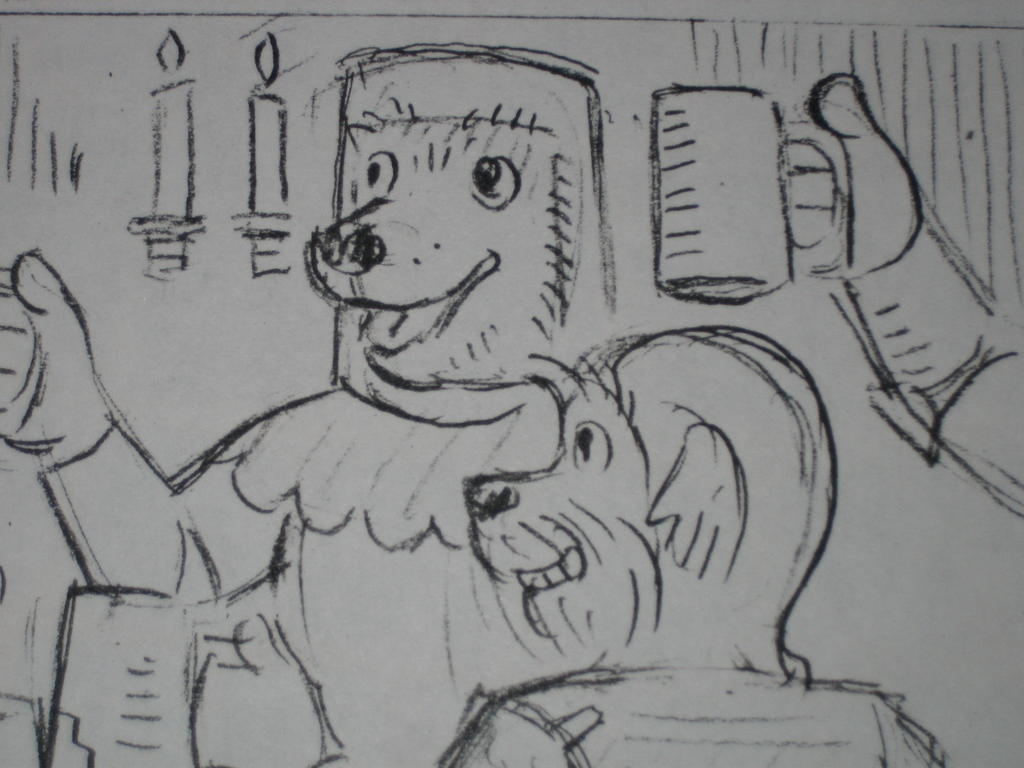
As with It's a Drag to Be a Dragon, feel free to share this with interested children. The only requirement is that it's read aloud (no kidding).
King Barkthur & The Nights At The Hounds' Table
(A Tail that Gives One Paws)
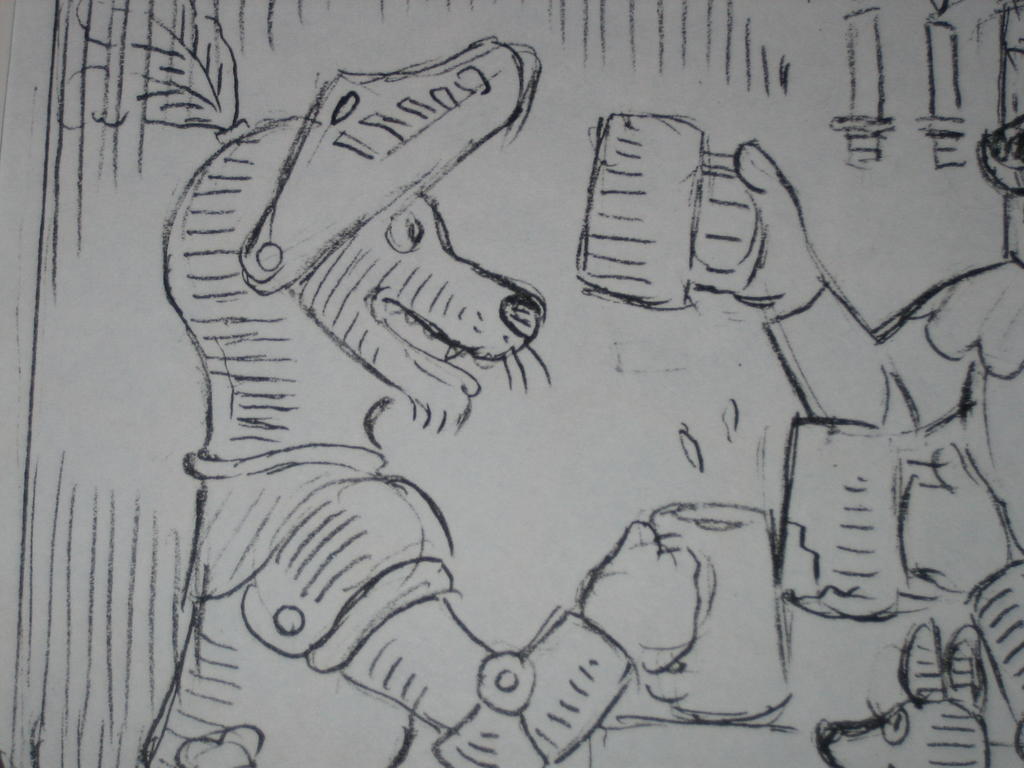
Once upon a time in a land called Canine-Lot, there lived a good, kind, and frisky pup named Barkthur. He fetched beautifully, spoke when spoken to, and washed his paws after every meal. He loved more than anything else to play and bark.
He sure wasn't the kind of dog that thought about becoming king.
Now Barkthur had a sister, named Dogbone Lamee. Dogbone was Barkthur's older sister, and everyone knows that older sisters are smart (if you want to check, just ask one).
In her heart of hearts, Dogbone Lamee knew that she was a natural leader of dogs. And because she could run with the pack and because she was smart, she knew that there was only one job for her.
She wanted to be Queen of Canine-Lot.
This is what happened instead.
One day, Barkthur and his friends were digging up the yard. Suddenly, Barkthur's nose hit something hard. It was a bone—a bone in a stone.
Barkthur licked his chops, took the bone in his teeth, and pulled it out.
The sky turned dark. Lightning flashed. Out of nowhere, an old shaggy dog appeared.
She looked around very slowly, and began to tell a shaggy dog story.
"I am the old sister of the old old king," she announced. "Before he died, he put this bone in this stone and he buried it here, deep deep in the ground. My brother said that whoever pulled the bone from the stone must be the next king.
Looking at Barkthur, she said, “Sorry, kid. All hail. In Dog We Trust.”
In a puff of smoke, she disappeared.
Barkthur knew that his days as a pup were over. He was now King Barkthur of Canine-Lot.
When Barkthur’s sister, Dogbone Lamee, heard what had happened, she howled with anger. "Whoever heard of becoming king simply from pulling a bone from a stone! What about brains? What about leadership skills?"
To be fair, she was right. Dogbone would make a great queen. There was only one thing to do. She headed for Canine-Lot to take the throne from her brother, the king.
Meanwhile, back at the castle, Barkthur appointed Furlin the Wizard as his advisor.
Furlin was the wisest animal in the kingdom. "If you listen to me you'll be a brilliant king. If you don't, you'll end up chasing your own tail."
And with Furlin's help, Barkthur did become a pretty good king.
But as we know, trouble was on the way.
Dogbone knew the name of every grumpy dog in the area. These dogs were bullies, and their gang was called the Ruff-Ruffians.
The Ruff-Ruffians chased smaller animals. They howled late at night when everyone else was trying to sleep. Ruff- Ruffians ran in packs. They upset every apple cart, and they dug up other people's lawns.
And so when Dogbone Lamee made her plan, she recognized right away that the best way to cause trouble for Barkthur (or throw a bone in the works, if you will) was to become the leader of the Ruff-Ruffians.
Dogbone arrived in the kingdom at midnight. Not being the sort to let sleeping dogs lie, she immediately got the Ruff-Ruffians all worked up. She rubbed their fur backwards, and made them chase their own tails.
With Dogbone Lamee at the lead, the Ruff-Ruffians jumped in lakes and shook their wet fur on everyone. They were taught to roll over and sit on smaller dogs -- in short, they learned every mean trick in the book.
Meanwhile, King Barkthur knew that something had to be done. Furlin wisely suggested Barkthur call the best and brightest dogs of the kingdom to help sort out the Ruff-Ruffian problem.
From all corners of the kingdom, dogs came running. Large dogs, strong dogs, dogs that could run very fast, dogs that could take orders, dogs that were loyal -- they all showed up at the castle and gathered around a large table to hear the king speak.
This was the famous Hounds' Table - perhaps you've heard of it?
Barkthur thanked them all for coming. He explained about the Ruff-Ruffians and his sister, Dogbone Lamee. It was a pretty good speech (Furlin wrote it).
When it was over, Barkthur asked the dogs if they would help him.
"I think you'd better keep your day jobs," he added, "just in case things don't work out." So from that day forward, the dogs began spending their nights at the Hounds' Table to protect the kingdom.
It was a big deal to be a Knight of the Hounds Table. One of the knights that everyone liked was called Sir Galahound. He was especially loved by the ladies. It was all he could do to keep them at bay.
Another popular pup was Sir Woof-A-Lot. Everyone knew when he was nearby. Sir Woof-A Lot woofed so much that he hardly ever heard anybody else. No one could even get a growl in edgewise.
Woof-A-Lot and Galahound were fun to play with. They became Barkthur's best friends.
And one day, Sir Woof-A-Lot's cousin, Kennel-Dear, came visiting from the kingdom next door. Kennel-Dear and Barkthur romped all over the place together.
They had such a good time that they decided to cut to the chase and get married. There were many milk toasts. It was a great day throughout the kingdom.
And guess what?
When Dogbone Lamee heard that someone else had become queen, she really became a mad dog! "This is so unfair, " she cried. "I'm the smart one. I know how to be a leader. I should be queen!"
So Dogbone made a second and better evil plan. There was a law back then with special claws, and the claws said that said anyone who traveled outside the kingdom was not allowed to return.
You see, there were fleas out there, and it was important not to wander off and then bring them back.
Dogbone Lamee told the Ruff Ruffians to steal Queen Kennel-dear's favorite dogbone and to throw it out past the kingdom's borders, with the fleas.
Poor Kennel-Dear stood at the edge of the kingdom and howled and cried and whimpered.
As luck would have it, Sir Woof-A-Lot wasn't woofing as much as usual (he was whistling instead). He happened to hear the Queen.
Because Woof-A-Lot was a very good knight, he ran outside the kingdom to fetch the bone. "But now I can't come back," Woof-A-Lot said, scratching at the fleas. "It's the law."
Kennel-Dear quickly trotted back to ask Barkthur to change the law. Barkthur thought that was a fine idea. But Furlin disagreed.
“If we change the law to make Woof-a-Lot happy,” he said, “we’ll end up making everyone else miserable. We’ll have fleas everywhere.”
And then Furlin repeated the word “fleas” a thousand times to show what he meant by a flea problem.
Several hours later, King Barkthur growled at his wizard," Thank you Furlin. I get your point." Barkthur lay down and put his chin on his paws. He thought and he thought and he thought. Finally, he raised his head.
"I know," Barkthur said. "I never wanted to be king in the first place. I'll let Dogbone become queen! Then Kennel-Dear and I can go off and play with Woof-A-Lot and Galahound. Everyone will happy!."
"Aren't you forgetting the fleas?" Furlin asked. Barkthur smiled.
"As my last duty as king, I command you to figure out a way to get rid of fleas. You're a wizard," Barkthur said. "You'll think of something."
And so Barkthur turned the throne over to his sister, who was very happy indeed. The first thing Queen Dogbone did was to tell the Ruff-Ruffians to behave. They did, and peace fell upon the land. She then moved on to agrarian reform.
Furlin put a magic spell on everyone's neckwear, thus inventing the flea collar. And since he knew that some dogs didn't like wearing collars, he also invented a magic flea powder that could be rubbed into the fur (Kennel-Dear liked this).
The flea law was abolished. Goods and services traveled freely between kingdoms from that day forward. And so did dogs.
And they all lived yappily ever after.
Copyright 2002 Annette Kramer; Images copyright 2002 Ron Barrett
Monday, December 19, 2005
Defining Leadership Skills: From the Classroom to the Boardroom
Over dinner, a friend (let's call him Ulysses) told me about a leadership elective he was teaching this semester to kids at a prep school.
Ulysses has maintained two careers in tandem. With a PhD from an Ivy League university, he teaches classical languages and literature while keeping a firm hand in high finance and philanthropy. He has very strong feelings about the qualities of leadership across contexts.
"The leadership elective is useless," Ulysses said. "It doesn't make sense. Leadership is not something you can recite or learn in the abstract."
After some thought, we decided leadership qualities in school and work combine charisma, expertise in an industry or subject, the ability to persuade, and confidence.
Confidence is particularly useful for some other necessary skills for leadership: the willingness to engage in meaningful conversation, to admit to being wrong, to learning what needs to change, and to make decisions even in the face of the unknown.
These are all disciplines very closely related to creativity in business. Instinct doesn't hurt either.
And So, In Short . . .
The necessary qualities for leadership must to be learned over time, outside the classroom as well as inside. Otherwise, "it's like an acting exercise," he said. You can look like a leader for an hour, but it won't work in off-stage.
My prestigious friend concluded that in order to integrate the work in different disciplines that combines to form leadership talent, both kids and adults need practice in different situations and to see what happens. Optimal results derive from integrating as many kinds of awareness and skill sets as possible.
But Wait, There's (Always) More
Another friend called Heather, a student and scholar of leadership and change, adds a provocative twist. After a careful study of the history and current divergent theories of business leadership, she concluded that the current climate is very much like the story in which a group of blind men mistook the parts of an elephant for the whole.
Where Myth and Management Meet
The story goes something like this: A group of blind men, all at different ends of an elephant, put their hands on the beast and declared definitively that an elephant is whatever they happened to touch.
One put his hand on the back and defined an elephant to be flat, dry, and wrinkly. Another touched the trunk and objected with great force that an elephant is long and tubular. A third stroked the leg, denied the first two claims, and definitively declared an elephant to be like a tree trunk. You get the point.
It's a remarkably astute observation on theory in general, and business leadership theory in particular. Pick a piece of the beast, and you'll find a different set of challenges and come up with a different set of solutions.
Heather has spent most of her life as a professional storyteller. Just another example of the ways in which crossing disciplines generates perspectives those too close to the elephant often miss.
For More On Thinking and Learning Generally
For related information on multiple intelligences vis a vis the discussion with Ulysses, see Howard Gardner's refelections on learning styles and capabilities. Howard Gardner is one of my heroes -- a neurologist by training who also studies the arts, corporate practice, and education.
As Frank McCourt has recently said in a talk at New York's 92nd Street Y, teachers themselves are never awarded the kind of prestige of any other profession. As McCourt points out, every TV panel on education contains a superintendant, a politician, and a professor of education but never someone who actually works in a classroom.
Howard Gardner has articulated for many educators’ ideas that no one would have heard otherwise. Of course, not to sell Gardner short, he also brings the perspective of a brilliant neuroscientist and scholar. Very useful for both credibility and making new connections.
All Kinds of Minds is an organization that provides resources for parents and teachers that works from Gardners' ideas, and is worth checking out as well.
For The Part the Elephant You Find in the Boardroom . . .
For another perspective on potential for thinking about business leadership in new ways, see Tom Harrison's book Instinct.
A biologist by training, Harrison talks about entrepreneurial DNA -- a useful metaphor for the potential to develop a collection of disciplines for effective leadership and innovation.
There's a lot of clearly articulated insight in Harrison's book, particularly in the way he offers new connections among old chestnuts.
My one caveat for Instinct: I am not big on quizzes because once there is an external standards, one tends to teach to (and learn for) the test. Exams tend to put one back into a passive way of thinking and to frame your thinking according to someone else's criteria.
If you take Harrison's tests, first make one up of yourself. Or use his as just the first in a series of new perspectives. What do YOU think makes a great entrepreneur and leader? What have you got that fits the bill? What have you got to learn? Where can you learn it?
Ulysses has maintained two careers in tandem. With a PhD from an Ivy League university, he teaches classical languages and literature while keeping a firm hand in high finance and philanthropy. He has very strong feelings about the qualities of leadership across contexts.
"The leadership elective is useless," Ulysses said. "It doesn't make sense. Leadership is not something you can recite or learn in the abstract."
After some thought, we decided leadership qualities in school and work combine charisma, expertise in an industry or subject, the ability to persuade, and confidence.
Confidence is particularly useful for some other necessary skills for leadership: the willingness to engage in meaningful conversation, to admit to being wrong, to learning what needs to change, and to make decisions even in the face of the unknown.
These are all disciplines very closely related to creativity in business. Instinct doesn't hurt either.
And So, In Short . . .
The necessary qualities for leadership must to be learned over time, outside the classroom as well as inside. Otherwise, "it's like an acting exercise," he said. You can look like a leader for an hour, but it won't work in off-stage.
My prestigious friend concluded that in order to integrate the work in different disciplines that combines to form leadership talent, both kids and adults need practice in different situations and to see what happens. Optimal results derive from integrating as many kinds of awareness and skill sets as possible.
But Wait, There's (Always) More
Another friend called Heather, a student and scholar of leadership and change, adds a provocative twist. After a careful study of the history and current divergent theories of business leadership, she concluded that the current climate is very much like the story in which a group of blind men mistook the parts of an elephant for the whole.
Where Myth and Management Meet
The story goes something like this: A group of blind men, all at different ends of an elephant, put their hands on the beast and declared definitively that an elephant is whatever they happened to touch.
One put his hand on the back and defined an elephant to be flat, dry, and wrinkly. Another touched the trunk and objected with great force that an elephant is long and tubular. A third stroked the leg, denied the first two claims, and definitively declared an elephant to be like a tree trunk. You get the point.
It's a remarkably astute observation on theory in general, and business leadership theory in particular. Pick a piece of the beast, and you'll find a different set of challenges and come up with a different set of solutions.
Heather has spent most of her life as a professional storyteller. Just another example of the ways in which crossing disciplines generates perspectives those too close to the elephant often miss.
For More On Thinking and Learning Generally
For related information on multiple intelligences vis a vis the discussion with Ulysses, see Howard Gardner's refelections on learning styles and capabilities. Howard Gardner is one of my heroes -- a neurologist by training who also studies the arts, corporate practice, and education.
As Frank McCourt has recently said in a talk at New York's 92nd Street Y, teachers themselves are never awarded the kind of prestige of any other profession. As McCourt points out, every TV panel on education contains a superintendant, a politician, and a professor of education but never someone who actually works in a classroom.
Howard Gardner has articulated for many educators’ ideas that no one would have heard otherwise. Of course, not to sell Gardner short, he also brings the perspective of a brilliant neuroscientist and scholar. Very useful for both credibility and making new connections.
All Kinds of Minds is an organization that provides resources for parents and teachers that works from Gardners' ideas, and is worth checking out as well.
For The Part the Elephant You Find in the Boardroom . . .
For another perspective on potential for thinking about business leadership in new ways, see Tom Harrison's book Instinct.
A biologist by training, Harrison talks about entrepreneurial DNA -- a useful metaphor for the potential to develop a collection of disciplines for effective leadership and innovation.
There's a lot of clearly articulated insight in Harrison's book, particularly in the way he offers new connections among old chestnuts.
My one caveat for Instinct: I am not big on quizzes because once there is an external standards, one tends to teach to (and learn for) the test. Exams tend to put one back into a passive way of thinking and to frame your thinking according to someone else's criteria.
If you take Harrison's tests, first make one up of yourself. Or use his as just the first in a series of new perspectives. What do YOU think makes a great entrepreneur and leader? What have you got that fits the bill? What have you got to learn? Where can you learn it?
Tuesday, December 13, 2005
Reconceiving PR: Two Creative Perspectives
Insight always packs the biggest punch when it's demonstrated rather than discussed. It's a the biggest reason that the concept of Thought Leadership desperately needs an overhaul as a brand-builder. I'm certainly not alone in this view.
David Weinberger and Jerry Michalski are two great thinkers on the subects of business, marketing, and brand.
Check out their ideas about new conceptions of PR -- more on creating new connections, relationships, and conversations.
David Weinberger and Jerry Michalski are two great thinkers on the subects of business, marketing, and brand.
Check out their ideas about new conceptions of PR -- more on creating new connections, relationships, and conversations.
Monday, December 12, 2005
Financial Services, Part 2: Sustainable Growth through Creativity
In the context of sustainable solutions for creativity in business, it seems appropriate to offer a second part of a previously posted conversation with a Partner in a Financial Services Firm.
Curiosity and Tenacity: Key Factors in Hiring
This high-level executive looks for curiosity, tenacity, and the kind of education that offers underlying discipline and confidence for effective problem-solving.
Here's a bit more on how his firm channels creativity to improve the bottom line:
AK: What concrete business case do you have for requiring curiosity in employees?
P: It's an equation that works like this: Problem-solving is a by-product of curiosity. You’ve got to be curious enough to deliver an effective outcome. That's how you make money, simple as that.
It's harder to sustain than you might think. You have to make sure the people who work for you are supported in their curiosity.
AK: So you're saying success in business involves taking care of employees? There's a lot of rhetoric around this in the business world, but how does it work? And is it really profitable?
P: Absolutely. Sustainability in a business model that people pay for. So I’ll pay a bigger multiple of earnings if I think your growth and innovative capacity is going to last forever. If I think the employees are well taken care of and earn stock, if they are supported, it's a big part of my decision to invest.
There are other issues as well that might help me make a decision. If the company has great corporate governance, if the management is super ethical, if they don't dump chemicals or kill trees, all these things are meaningful to investors.
These things were all overlooked for a while -- the economy was chugging along, but the world becomes increasingly complicated and interconnected.
AK: I'd like to hear more about how you support your employee's curiosity to sustain innovation and grow your business.
Would you elaborate on the ways your firm encourages or demands that employees find new ways of looking at the world to this end?
P: Sure. We put a lot of effort into providing opportunities to learn, and not just directly related to finance per se.
We support our people in going back to school and get advanced degrees, or take classes just because they're interested in a subject. The courses feed their curiosity and also provide ways to do better due diligence in the subject area.
In the end, we see the benefits for our company and our investors.
AK: Your employees get higher degrees in subjects other than straight business or economics? Can you give me an example?
P: Sure. There may be someone here who is fascinated by technology. He’ll go to a professor in NYU and learn how all the latest, hottest applications work. In the process, this person is also learning about the current state of industry, which products work, and how companies do customer service -- the whole gamut.
Once they get degrees, this employee is not just a finance guy -- he's also technologists. He can go out and question the industry and make investment decisions with having a real knowledge about what to ask. He has a sense of what's credible -- in your words -- and useful in a way that someone who just studies business would never get.
AK: Are there other benefits?
P: Sure. Knowing how to do this in one field is transferable to others. Like you said, learning is associative -- once you learn a process in one context, you can apply to a field that's unfamiliar. That's very useful to us.
AK: You said earlier that looking at patterns in one field can trigger curiousity in another about what doesn't fit and requires more investigation. Can you elaborate?
P: Here's an example. If you have a public company that declares its earnings, you have to understand that there are different possibilities of what’s true. Presentation of information that looks credible may have something behind it other than what it seems.
The specifics change from situation to situation. It's important to be able to be flexible and curious enough to investigate patterns when the data changes -- it's a creative process.
AK: This seems to go back to what we were saying about the value of making new connections among seemingly familiar pieces of information.
P: Right. This is an evolving industry on Wall Street. I mean, look at values-based research, for example. It's socially responsible investing -- looking at companies and their compensation and corporate governance and employee healthcare which typically people didn’t look at before.
More and more, there are research firms doing off pieced research products. This can tell you so much more than the basic income statement, value sheet, earnings, growth, and all that that we’re used to seeing.
AK: So what these firms are tying to do is get people to look at the market in a new way, to see it new.
P: Short-term thinking doesn't work long-term. Sophisticated investors understand that, and we help our clients recognize the value.
At the end of the day, a company's earning growth is not sustainable if it hasn't got good corporate governance and doesn't support its employees.
Curiosity and Tenacity: Key Factors in Hiring
This high-level executive looks for curiosity, tenacity, and the kind of education that offers underlying discipline and confidence for effective problem-solving.
Here's a bit more on how his firm channels creativity to improve the bottom line:
AK: What concrete business case do you have for requiring curiosity in employees?
P: It's an equation that works like this: Problem-solving is a by-product of curiosity. You’ve got to be curious enough to deliver an effective outcome. That's how you make money, simple as that.
It's harder to sustain than you might think. You have to make sure the people who work for you are supported in their curiosity.
AK: So you're saying success in business involves taking care of employees? There's a lot of rhetoric around this in the business world, but how does it work? And is it really profitable?
P: Absolutely. Sustainability in a business model that people pay for. So I’ll pay a bigger multiple of earnings if I think your growth and innovative capacity is going to last forever. If I think the employees are well taken care of and earn stock, if they are supported, it's a big part of my decision to invest.
There are other issues as well that might help me make a decision. If the company has great corporate governance, if the management is super ethical, if they don't dump chemicals or kill trees, all these things are meaningful to investors.
These things were all overlooked for a while -- the economy was chugging along, but the world becomes increasingly complicated and interconnected.
AK: I'd like to hear more about how you support your employee's curiosity to sustain innovation and grow your business.
Would you elaborate on the ways your firm encourages or demands that employees find new ways of looking at the world to this end?
P: Sure. We put a lot of effort into providing opportunities to learn, and not just directly related to finance per se.
We support our people in going back to school and get advanced degrees, or take classes just because they're interested in a subject. The courses feed their curiosity and also provide ways to do better due diligence in the subject area.
In the end, we see the benefits for our company and our investors.
AK: Your employees get higher degrees in subjects other than straight business or economics? Can you give me an example?
P: Sure. There may be someone here who is fascinated by technology. He’ll go to a professor in NYU and learn how all the latest, hottest applications work. In the process, this person is also learning about the current state of industry, which products work, and how companies do customer service -- the whole gamut.
Once they get degrees, this employee is not just a finance guy -- he's also technologists. He can go out and question the industry and make investment decisions with having a real knowledge about what to ask. He has a sense of what's credible -- in your words -- and useful in a way that someone who just studies business would never get.
AK: Are there other benefits?
P: Sure. Knowing how to do this in one field is transferable to others. Like you said, learning is associative -- once you learn a process in one context, you can apply to a field that's unfamiliar. That's very useful to us.
AK: You said earlier that looking at patterns in one field can trigger curiousity in another about what doesn't fit and requires more investigation. Can you elaborate?
P: Here's an example. If you have a public company that declares its earnings, you have to understand that there are different possibilities of what’s true. Presentation of information that looks credible may have something behind it other than what it seems.
The specifics change from situation to situation. It's important to be able to be flexible and curious enough to investigate patterns when the data changes -- it's a creative process.
AK: This seems to go back to what we were saying about the value of making new connections among seemingly familiar pieces of information.
P: Right. This is an evolving industry on Wall Street. I mean, look at values-based research, for example. It's socially responsible investing -- looking at companies and their compensation and corporate governance and employee healthcare which typically people didn’t look at before.
More and more, there are research firms doing off pieced research products. This can tell you so much more than the basic income statement, value sheet, earnings, growth, and all that that we’re used to seeing.
AK: So what these firms are tying to do is get people to look at the market in a new way, to see it new.
P: Short-term thinking doesn't work long-term. Sophisticated investors understand that, and we help our clients recognize the value.
At the end of the day, a company's earning growth is not sustainable if it hasn't got good corporate governance and doesn't support its employees.
Monday, December 05, 2005
More Sustainable Practices to Support Creativity in Business: Conflict, Part 2
In consultant fashion, my writing often begins with a problem brought to me by someone in a bit of a pickle.
The Weekly Pickle
This week, a writer friend (let's call her Jane) told me about her frustration with the way conflict is handled at work. Jane is tremendously bright, has a great deal of experience as a writer and thinker, and works in a department that generates insight papers for a large corporate concern.
Jane's Challenge
When conflict arises -- either in a planning meeting or in an interview -- those controlling the agenda insist on eliminating tension as quickly as possible.
It's a rather counterproductive tendency aimed at restoring a level of emotional comfort and a sense that everyone's on the same team. In conversations designed to uncover new insights, polite discussion becomes the priority over exploring new territory.
If necessary, consensus is achieved by force -- contradictions are denied, and the higher-ranking people at the table change the subject or claim resolution without actually achieving it.
An Alternative Strategy
Someone else my friend and I both know (let's call him Max) does a beautiful job at turning this sort of situation around. When conflict arises, Max calmly refuses the be turned away from the original topic at hand.
Sometimes square in face of hierarchical convention, Max highlights the manner in which viewpoints diverge or conflict after the subject has been dismissed. However, he also offers ways to explore the relationships among opposing perspectives.
When resolution is impossible, Max encourages the room to be curious about contradiction and suggests that this fact is as much a topic worthy of investigation as any particular point of view.
See Max Run
It must be said that part of Max's ability to do this comes from the fact that he is a man. When he speaks, he is heard in a way that my other, female friend is not.
On the other hand, this does not take anything away from Max's accomplishments. He is willing to be curious aloud in the face of longstanding business convention that sees contradiction among peers as a problem.
Max persistently, quietly insists that opposition is not to be feared but instead must be acknowledged where it lies. Otherwise, how can writers reach the real inisights the company seeks?
Max's Methods
Max's methods are various: charisma, brilliance, gentleness, persistence, and gravitas. However, his greatest strength is that he reframes the conflict in terms that take away the emotional acrimony -- or fear of it arising.
Debate can generate as much emotional as cerebral investment, and in a business context, feelings can be uncomfortable. In addition, positions start to feel personal -- conflict can imply winners and losers, and who wants to end up giving ground? Max stands back from the situation and allows others to do the same. It leaves everyone freer to be curious.
Sometimes it doesn't work -- the people you work with have to be willing to see things new, or even the most persuasive voices will not move them. Being open to new ideas works best when it's rewarded from the highest levels of any business.
So Where Does This Lead?
Sometimes talking things through can allow a group to see that they actually agree or find a new, better idea generated collectively. Conversation can an excellent discipline for finding the overlap in seemingly disparate perspectives.
However, it is childish to believe that there is only one right answer, that all contradiction can be resolved, and that everyone can come to agree about issues around which they have vastly different experience. Lines of reasoning often run parallel or at angles to each other, and the feelings that support intellectual positions will not disappear even if they are forcibly dismissed.
And So?
If opposition is inevitable, why not use the abundant energy it generates for discovery? Discomfort is part of the game sometimes -- after all, embarking on new journeys can be very disorganizing. On the other hand, how can you uncover new insights without exploring what you don't already know?
The Weekly Pickle
This week, a writer friend (let's call her Jane) told me about her frustration with the way conflict is handled at work. Jane is tremendously bright, has a great deal of experience as a writer and thinker, and works in a department that generates insight papers for a large corporate concern.
Jane's Challenge
When conflict arises -- either in a planning meeting or in an interview -- those controlling the agenda insist on eliminating tension as quickly as possible.
It's a rather counterproductive tendency aimed at restoring a level of emotional comfort and a sense that everyone's on the same team. In conversations designed to uncover new insights, polite discussion becomes the priority over exploring new territory.
If necessary, consensus is achieved by force -- contradictions are denied, and the higher-ranking people at the table change the subject or claim resolution without actually achieving it.
An Alternative Strategy
Someone else my friend and I both know (let's call him Max) does a beautiful job at turning this sort of situation around. When conflict arises, Max calmly refuses the be turned away from the original topic at hand.
Sometimes square in face of hierarchical convention, Max highlights the manner in which viewpoints diverge or conflict after the subject has been dismissed. However, he also offers ways to explore the relationships among opposing perspectives.
When resolution is impossible, Max encourages the room to be curious about contradiction and suggests that this fact is as much a topic worthy of investigation as any particular point of view.
See Max Run
It must be said that part of Max's ability to do this comes from the fact that he is a man. When he speaks, he is heard in a way that my other, female friend is not.
On the other hand, this does not take anything away from Max's accomplishments. He is willing to be curious aloud in the face of longstanding business convention that sees contradiction among peers as a problem.
Max persistently, quietly insists that opposition is not to be feared but instead must be acknowledged where it lies. Otherwise, how can writers reach the real inisights the company seeks?
Max's Methods
Max's methods are various: charisma, brilliance, gentleness, persistence, and gravitas. However, his greatest strength is that he reframes the conflict in terms that take away the emotional acrimony -- or fear of it arising.
Debate can generate as much emotional as cerebral investment, and in a business context, feelings can be uncomfortable. In addition, positions start to feel personal -- conflict can imply winners and losers, and who wants to end up giving ground? Max stands back from the situation and allows others to do the same. It leaves everyone freer to be curious.
Sometimes it doesn't work -- the people you work with have to be willing to see things new, or even the most persuasive voices will not move them. Being open to new ideas works best when it's rewarded from the highest levels of any business.
So Where Does This Lead?
Sometimes talking things through can allow a group to see that they actually agree or find a new, better idea generated collectively. Conversation can an excellent discipline for finding the overlap in seemingly disparate perspectives.
However, it is childish to believe that there is only one right answer, that all contradiction can be resolved, and that everyone can come to agree about issues around which they have vastly different experience. Lines of reasoning often run parallel or at angles to each other, and the feelings that support intellectual positions will not disappear even if they are forcibly dismissed.
And So?
If opposition is inevitable, why not use the abundant energy it generates for discovery? Discomfort is part of the game sometimes -- after all, embarking on new journeys can be very disorganizing. On the other hand, how can you uncover new insights without exploring what you don't already know?
Monday, November 28, 2005
More on Conflict and Creativity
I've been considering the wider value of conflict for creativity after the last post. Through what processes can value be derived from something so uncomfortable in contexts other than the arts?
Fight, Flight, or Something Else?
Here's a start: conflict is as much heartfelt as it is intellectually-based, and debate itself implies a winner and a loser. This in itself often affects one's willingness to entertain an alternative viewpoint. Giving ground only happens in battle when there is no other choice.
On the other hand, emotional engagement can be turned to the advantage of innovation, if competitors in business or a classroom can entertain a common goal at the same time as their conflicting positions. Emotional impulse is essential for inspiration, and if, regardless of discomfort, one is looking for new connections and ideas, what better place is there than conflict to find some?
The trick is to entertain an awareness of immediate emotional impulses and the larger picture at the same time. Knowing that feelings pass, change, transform over time, one can train oneself to step back from defending them with eyes closed to being curious about them, their causes, and their alternatives.
Harnessing the Value of Opposition
Clearly, conflict without discipline and an understanding of how to apply its principles will generate stagnant or (worse) growing acrimony. However, what is not done with love can be done with discipline. The same components that go into effective thinking are necessary to generate useful solutions, even if the result solves a problem separate from the conflict at hand.
Conflict is useful when it can be part of a conversation, either internal, external, or both. This exchange must balance the relationship among critical thinking skills, observations, analyses, and emotional engagement. Above all, it requires awareness of process.
Improv: More Than Just for Mimes
There's no trick, there's no formula, and it’s improvisation. Each case is different and participants need the drive to be curious about what's new across contexts. Traditionally, improv is famous for the willingness to entertain an attitude of "Yes AND" rather than "Yes BUT" for long periods of time -- and to just see what happens. It requires endurance, discipline, empathy, and the creativity to see value in situations over which you only have a small amount of control.
This empathy requires courage -- to stretch from a comfortable and long-held stance and exchange it for an unknown -- and perhaps uncomfortable or long-opposed -- point of view. This allows new patterns to emerge, regardless of the last stand you decide to take.
Without opposition, nothing new will emerge. Change is hard because it is unfamiliar, but comfortable, familiar situations rarely breed new ideas.
Chaos Out of Order: The First Step
Improvisation becomes more comfortable with practice. It's harder than it sounds, and requires a great deal of discipline to be curious, to wonder about new patterns, even when the context is unfamiliar.
Those who recognize that a certain amount of chaos is a necessary part of the creative process tend to enjoy it and engage in it more than those who don't understand that learning is disorganizing. You're inevitably walking into unfamiliar territory if you let go of the existing order to find something new.
Take responsibility for creating this kind of chaos, see it as living in disorder as part of a process, and it becomes increasingly easier to remain curious -- even in a hurricane of opposition -- as you gain confidence in your own ability to make new order when the storm has passed.
Fight, Flight, or Something Else?
Here's a start: conflict is as much heartfelt as it is intellectually-based, and debate itself implies a winner and a loser. This in itself often affects one's willingness to entertain an alternative viewpoint. Giving ground only happens in battle when there is no other choice.
On the other hand, emotional engagement can be turned to the advantage of innovation, if competitors in business or a classroom can entertain a common goal at the same time as their conflicting positions. Emotional impulse is essential for inspiration, and if, regardless of discomfort, one is looking for new connections and ideas, what better place is there than conflict to find some?
The trick is to entertain an awareness of immediate emotional impulses and the larger picture at the same time. Knowing that feelings pass, change, transform over time, one can train oneself to step back from defending them with eyes closed to being curious about them, their causes, and their alternatives.
Harnessing the Value of Opposition
Clearly, conflict without discipline and an understanding of how to apply its principles will generate stagnant or (worse) growing acrimony. However, what is not done with love can be done with discipline. The same components that go into effective thinking are necessary to generate useful solutions, even if the result solves a problem separate from the conflict at hand.
Conflict is useful when it can be part of a conversation, either internal, external, or both. This exchange must balance the relationship among critical thinking skills, observations, analyses, and emotional engagement. Above all, it requires awareness of process.
Improv: More Than Just for Mimes
There's no trick, there's no formula, and it’s improvisation. Each case is different and participants need the drive to be curious about what's new across contexts. Traditionally, improv is famous for the willingness to entertain an attitude of "Yes AND" rather than "Yes BUT" for long periods of time -- and to just see what happens. It requires endurance, discipline, empathy, and the creativity to see value in situations over which you only have a small amount of control.
This empathy requires courage -- to stretch from a comfortable and long-held stance and exchange it for an unknown -- and perhaps uncomfortable or long-opposed -- point of view. This allows new patterns to emerge, regardless of the last stand you decide to take.
Without opposition, nothing new will emerge. Change is hard because it is unfamiliar, but comfortable, familiar situations rarely breed new ideas.
Chaos Out of Order: The First Step
Improvisation becomes more comfortable with practice. It's harder than it sounds, and requires a great deal of discipline to be curious, to wonder about new patterns, even when the context is unfamiliar.
Those who recognize that a certain amount of chaos is a necessary part of the creative process tend to enjoy it and engage in it more than those who don't understand that learning is disorganizing. You're inevitably walking into unfamiliar territory if you let go of the existing order to find something new.
Take responsibility for creating this kind of chaos, see it as living in disorder as part of a process, and it becomes increasingly easier to remain curious -- even in a hurricane of opposition -- as you gain confidence in your own ability to make new order when the storm has passed.
Thursday, November 24, 2005
Conflict: Should It Always Be Resolved?
Conflict can be uncomfortable, no question. How many corporate dollars and hours go into workshops that aim to resolve it?
What happens if you allow conflict to continue exist, even as you apply curiosity and analysis to it?
Getting away from explicit approaches to creativity in business, l found this approach startlingly useful in another context.
A Little Background
Groups like the Creative Arts Team (CAT) in New York do a great service by teaching conflict resolution in schools and giving voice to seemingly contradictory positions to develop empathy and better social relations. It's not news that kids and adolescents can feel particularly confused about their feelings -- and about ways of showing them, articulating them, and behaving when under their influence.
CAT demonstrates that the value of drama here is not theoretical. The group offers ways in which conflict and creativity can develop new insights. Check them out if you know of a school that can use them.
And by the way, their work is much more powerful than their website.
An Extreme But Specific Example
Through CAT, I was involved with in the first Palestinian, Israeli, Jordanian adult theater collaboration after Oslo. This took place in New York, by the way. I had spent a few months the year before writing about such productions in Jerusalem, but all cast members in those cases were Israeli citizens. I had written one story for The Voice, and they offered me the chance to do another.
Through an actor with whom I worked with before and my own strong feelings about theater, I gained the trust of the rest of the group and was became the only reporter allowed in rehearsals by the Palestinian Authority.
It was a remarkable experience in its extreme focus on the question of whether or not it's possible to resolve conflict and the kind of creativity required to remain curious about the question, both personally and professionally.
Like the Palestinian/Israeli productions about which I had previously reported, individuals were forced to simultaneously sustain their emotional histories as citizens while as professional actors they had expressly come to collaborate with those they considered the enemy for artistic reasons.
All of the Israeli participants had served in the army and continued in the reserves. Many had lost family and friends to these wars. All of the other participants had lost at least one family member as well to the Israeli armies.
What made it more complex is that even those of the same nationality didn't agree on politics or share the same socio-economic background. Artistically they differed as well -- the Israeli acting style was more European and naturalistic while the Palestinian and Jordanians had a more presentational approach.
Rehearsals were built on each cast-member's stories. Although the specifics varied widely, they all shared a great deal of pain from trauma that felt fresh. Clearly, there was a desire to move forward or none would be working on the show in the first place. However, in each case, there had been a history of both nursing specific grievances and of healing them.
The national stories and mythologies complicated the interactions further, and arguments broke out regularly. However, as days past and everyone began to understand each other's perspective, respect and genuine affection grew amidst the anger and pain. One comment I heard a lot: "I love these individuals, but I hate their countries."
Amazing Insights But Bad Theater
Ultimately, the play's story comprised a fictionalized collective history of the group. Unfortunately, the production was a lot less complex or interesting than the rehearsals to which only I was privy.
However, I don't think it's for the reason Tristan Tzara says in Tom Stoppard's Travesties: "the odd thing about the revolution is that the further left you go politically, the more bourgeois they like their art."
Most of these artists were heavily influenced by theater more abstract than Anglo/American contemporary work, so the social constructivist sort of art they produced was not really what any had in mind when they started.
It seemed that the energy it took to come to a common language among themselves made it important to be clear about their intentions onstage for themselves as much as for the audience. The internal disagreements and conflicting national loyalties remained side-by-side with the personal connections and affection each felt for the other. They had come too far in their respect for each other's differences to harbor any ambiguity of purpose when it came to the production.
Still, A Creative Coup
However, there were remarkable creative insight that could only have resulted from this deepest-felt constant conflict, pain, and argument. It was the emotional understanding that each gained into the otherwise abstract principles and experience of the others they considered enemies. The fact that intellect and feeling could combine while holding opposing points of view -- enemy and friend -- simultaneously was the insight that came out of this work.
Unfortunately, it's one of those experiences that might be hard to understand on a gut level without having lived through the details. My point is that conflict can generate insights creatively that would be impossible to discover otherwise.
After all, inspiration is the meeting point of intellectual and emotional insight. The ultimate results -- good art, bad theater, applicable solutions, theoretical impossibilities -- come from the skill with which one works with other necessary elements for innovation. This usually holds true across contexts.
More in future posts.
What happens if you allow conflict to continue exist, even as you apply curiosity and analysis to it?
Getting away from explicit approaches to creativity in business, l found this approach startlingly useful in another context.
A Little Background
Groups like the Creative Arts Team (CAT) in New York do a great service by teaching conflict resolution in schools and giving voice to seemingly contradictory positions to develop empathy and better social relations. It's not news that kids and adolescents can feel particularly confused about their feelings -- and about ways of showing them, articulating them, and behaving when under their influence.
CAT demonstrates that the value of drama here is not theoretical. The group offers ways in which conflict and creativity can develop new insights. Check them out if you know of a school that can use them.
And by the way, their work is much more powerful than their website.
An Extreme But Specific Example
Through CAT, I was involved with in the first Palestinian, Israeli, Jordanian adult theater collaboration after Oslo. This took place in New York, by the way. I had spent a few months the year before writing about such productions in Jerusalem, but all cast members in those cases were Israeli citizens. I had written one story for The Voice, and they offered me the chance to do another.
Through an actor with whom I worked with before and my own strong feelings about theater, I gained the trust of the rest of the group and was became the only reporter allowed in rehearsals by the Palestinian Authority.
It was a remarkable experience in its extreme focus on the question of whether or not it's possible to resolve conflict and the kind of creativity required to remain curious about the question, both personally and professionally.
Like the Palestinian/Israeli productions about which I had previously reported, individuals were forced to simultaneously sustain their emotional histories as citizens while as professional actors they had expressly come to collaborate with those they considered the enemy for artistic reasons.
All of the Israeli participants had served in the army and continued in the reserves. Many had lost family and friends to these wars. All of the other participants had lost at least one family member as well to the Israeli armies.
What made it more complex is that even those of the same nationality didn't agree on politics or share the same socio-economic background. Artistically they differed as well -- the Israeli acting style was more European and naturalistic while the Palestinian and Jordanians had a more presentational approach.
Rehearsals were built on each cast-member's stories. Although the specifics varied widely, they all shared a great deal of pain from trauma that felt fresh. Clearly, there was a desire to move forward or none would be working on the show in the first place. However, in each case, there had been a history of both nursing specific grievances and of healing them.
The national stories and mythologies complicated the interactions further, and arguments broke out regularly. However, as days past and everyone began to understand each other's perspective, respect and genuine affection grew amidst the anger and pain. One comment I heard a lot: "I love these individuals, but I hate their countries."
Amazing Insights But Bad Theater
Ultimately, the play's story comprised a fictionalized collective history of the group. Unfortunately, the production was a lot less complex or interesting than the rehearsals to which only I was privy.
However, I don't think it's for the reason Tristan Tzara says in Tom Stoppard's Travesties: "the odd thing about the revolution is that the further left you go politically, the more bourgeois they like their art."
Most of these artists were heavily influenced by theater more abstract than Anglo/American contemporary work, so the social constructivist sort of art they produced was not really what any had in mind when they started.
It seemed that the energy it took to come to a common language among themselves made it important to be clear about their intentions onstage for themselves as much as for the audience. The internal disagreements and conflicting national loyalties remained side-by-side with the personal connections and affection each felt for the other. They had come too far in their respect for each other's differences to harbor any ambiguity of purpose when it came to the production.
Still, A Creative Coup
However, there were remarkable creative insight that could only have resulted from this deepest-felt constant conflict, pain, and argument. It was the emotional understanding that each gained into the otherwise abstract principles and experience of the others they considered enemies. The fact that intellect and feeling could combine while holding opposing points of view -- enemy and friend -- simultaneously was the insight that came out of this work.
Unfortunately, it's one of those experiences that might be hard to understand on a gut level without having lived through the details. My point is that conflict can generate insights creatively that would be impossible to discover otherwise.
After all, inspiration is the meeting point of intellectual and emotional insight. The ultimate results -- good art, bad theater, applicable solutions, theoretical impossibilities -- come from the skill with which one works with other necessary elements for innovation. This usually holds true across contexts.
More in future posts.
Wednesday, November 16, 2005
One More Thought On Sustainable Solutions
After a stimulating conversation with an admired colleague who is both an ethnographer and business executive, it seems a shame to abandon the notion of sustainable solutions for innovation where it was left yesterday. Based on our discussion, I'd like to add something that occurred to both of us.
Even if there is no time immediately to go into schools where learning starts -- and this is something I recommend highly -- sustainable solutions for innovation can be achieved by crossing silos within the business community alone.
Creativity is the ability to learn continuously across contexts. Begin with culture, research in situ and find out what works in the language of each discipline or field. Present the results on film, through blogs, on radio -- in whatever medium has the most immediacy for those involved. Then take the various languages of different cultures and translate what works across contexts.
Cross disciplines and see things new. Then leverage the resources that have been available all along but hidden in foreign languages and cultures.
A Note on Best Practices
Professional researchers should oversee and analyze the various processes who have no direct allegiance to any of the cultures being studied. Although there is no such thing as objectivity, it's important to have analysts who do not directly benefit financially from any particular process among which the different cultures are negotiating.
The Sustainable Part
As with learning of any kind, the discovery and introduction of new ideas is only the first step. Persist, develop, experiment, collaborate over time with diplomats from each culture continuing conversations both in person and through further research.
As new ideas become old hat, introduce new voices, unfamiliar disciplines, surprising alliances to force yourself to see things new. Patterns and processes will emerge as a kind of cross-disciplinary literacy that can sustain innovation across contexts.
Even if there is no time immediately to go into schools where learning starts -- and this is something I recommend highly -- sustainable solutions for innovation can be achieved by crossing silos within the business community alone.
Creativity is the ability to learn continuously across contexts. Begin with culture, research in situ and find out what works in the language of each discipline or field. Present the results on film, through blogs, on radio -- in whatever medium has the most immediacy for those involved. Then take the various languages of different cultures and translate what works across contexts.
Cross disciplines and see things new. Then leverage the resources that have been available all along but hidden in foreign languages and cultures.
A Note on Best Practices
Professional researchers should oversee and analyze the various processes who have no direct allegiance to any of the cultures being studied. Although there is no such thing as objectivity, it's important to have analysts who do not directly benefit financially from any particular process among which the different cultures are negotiating.
The Sustainable Part
As with learning of any kind, the discovery and introduction of new ideas is only the first step. Persist, develop, experiment, collaborate over time with diplomats from each culture continuing conversations both in person and through further research.
As new ideas become old hat, introduce new voices, unfamiliar disciplines, surprising alliances to force yourself to see things new. Patterns and processes will emerge as a kind of cross-disciplinary literacy that can sustain innovation across contexts.
What Happened Next (And Why It's Important)
In the first workshop at the primary school conference, participants went around the room offering names, experience, grade level, and reason for attending.
As the other teachers introduced themselves, it became clear that they all knew each other either because they taught together or because they shared colleagues elsewhere. Typical dialogue went something like this: "Hi, my name is Sophie, I teach third grade in Bedford, and I'm here to find out how to get my kids to like writing." You'd then hear, "Oh, Bedford -- I worked with your first grade teacher on phonics." And so it went until it was my turn.
Crossing Silos
I was the only attendee who consulted to teachers rather than who currrently occupied a classroom of my own. I gave my name, and said, "I taught at Brown for five years and am here to investigate the reasons for which my students were so sophisticated in certain thinking skills and so weak in others."
For a moment, I was afraid I had insulted everyone in the room. However, I was immediately flooded with handshakes and enthusiastic welcomes --none of these primary school teachers had ever spoken to someone who taught on the college level.
I was stunned -- and it raised this question:
How can a primary school teacher prepare her students to be effective writers and critical thinkers if she has never spoken to a university teacher about the standards and demands for which her students are headed? And worse yet for employers, how can future workers gain the skills necessary if no one is talking to them from the beginning of formal education?
Although there are exceptions, the situation turned out to surprise me even further: No teachers of any age group speak about common goals to the teachers in the next school to which they directly hand off their classes.
In other words, pre-school teachers don't seem to talk to primary school teachers. Primary school teachers don't talk to high school teachers, high school teachers didn't talk to university teachers, and university teachers don't talk to the people in business who would provide the context for these graduates learning lives ever after.
Sir Ken Robinson claims that our current education system is an elongated preparation for university -- to create university professors. I would agree that this is the implicit principle, but even without taking into consideration preparation for employment, even Sir Ken's idea is not well executed.
Cultural Silos are the Norm
According to these teachers and some in England with whom I've worked, there are exceptions on the academic level. Districts sometimes bring teachers together, although their priorities are often so different that there need to be special meetings just to find common ground.
Businesses, too, create forums in which they speak to students -- about careers, about particular business needs, and other topics that concern them. But these business leaders don't speak to teachers.
In fact, it's administrators who remain the only connections among learning environments -- from primary school through their first jobs.
A Sustainable Solution: Start with Culture
To understand the obstacles to conversations among key stakeholders, it's first essential to investigate the cultures that keep each group of isolated from the others when it comes to developing sustainable practices for innovation. The language high school teachers use to express successful thinking is quite different from that of business management, but the concepts are strikingly the same.
Once cultures were studied and investigated, what if there were regular conferences to which college professors and business leaders came together with primary, middle, and secondary school teachers -- and employers -- to discuss their expectations, needs, and challenges?
What if the cultures were discussed explicitly -- and common challenges and needs translated into common terms -- to leverage the resources of multiple fields all aiming toward the same goals?
If we could keep the conversation going among the key stakeholders perhaps we could crack this dearth of critical and creative thinking. Understand how to translate process among cultures, and this problem can be solved.
As the other teachers introduced themselves, it became clear that they all knew each other either because they taught together or because they shared colleagues elsewhere. Typical dialogue went something like this: "Hi, my name is Sophie, I teach third grade in Bedford, and I'm here to find out how to get my kids to like writing." You'd then hear, "Oh, Bedford -- I worked with your first grade teacher on phonics." And so it went until it was my turn.
Crossing Silos
I was the only attendee who consulted to teachers rather than who currrently occupied a classroom of my own. I gave my name, and said, "I taught at Brown for five years and am here to investigate the reasons for which my students were so sophisticated in certain thinking skills and so weak in others."
For a moment, I was afraid I had insulted everyone in the room. However, I was immediately flooded with handshakes and enthusiastic welcomes --none of these primary school teachers had ever spoken to someone who taught on the college level.
I was stunned -- and it raised this question:
How can a primary school teacher prepare her students to be effective writers and critical thinkers if she has never spoken to a university teacher about the standards and demands for which her students are headed? And worse yet for employers, how can future workers gain the skills necessary if no one is talking to them from the beginning of formal education?
Although there are exceptions, the situation turned out to surprise me even further: No teachers of any age group speak about common goals to the teachers in the next school to which they directly hand off their classes.
In other words, pre-school teachers don't seem to talk to primary school teachers. Primary school teachers don't talk to high school teachers, high school teachers didn't talk to university teachers, and university teachers don't talk to the people in business who would provide the context for these graduates learning lives ever after.
Sir Ken Robinson claims that our current education system is an elongated preparation for university -- to create university professors. I would agree that this is the implicit principle, but even without taking into consideration preparation for employment, even Sir Ken's idea is not well executed.
Cultural Silos are the Norm
According to these teachers and some in England with whom I've worked, there are exceptions on the academic level. Districts sometimes bring teachers together, although their priorities are often so different that there need to be special meetings just to find common ground.
Businesses, too, create forums in which they speak to students -- about careers, about particular business needs, and other topics that concern them. But these business leaders don't speak to teachers.
In fact, it's administrators who remain the only connections among learning environments -- from primary school through their first jobs.
A Sustainable Solution: Start with Culture
To understand the obstacles to conversations among key stakeholders, it's first essential to investigate the cultures that keep each group of isolated from the others when it comes to developing sustainable practices for innovation. The language high school teachers use to express successful thinking is quite different from that of business management, but the concepts are strikingly the same.
Once cultures were studied and investigated, what if there were regular conferences to which college professors and business leaders came together with primary, middle, and secondary school teachers -- and employers -- to discuss their expectations, needs, and challenges?
What if the cultures were discussed explicitly -- and common challenges and needs translated into common terms -- to leverage the resources of multiple fields all aiming toward the same goals?
If we could keep the conversation going among the key stakeholders perhaps we could crack this dearth of critical and creative thinking. Understand how to translate process among cultures, and this problem can be solved.
Tuesday, November 15, 2005
Innovative Thinking: Working Toward a Sustainable Solution
In three plus years of conversations, leaders across contexts articulated the process of successful thinking somewhere within the parameters of the creative process I outlined in the last post. This sample included prominent educators, psychologists, small business owners, parents, and corporate giants.
So if international leaders -- from primary school teachers to CEOs -- want to develop the same innovative capabilities in their charges, why are creative thinkers said to be so scarce?
Conversation as Best Practices
The first step is for stakeholders in different fields to begin conversations about common needs and find a sustainable solution together.
Let's start where learning begins formally. It became strikingly clear to me that crossing silos can be a sustainable solution to innovation when I attended a primary school conference on writing skills in a New York suburb last year.
Why a Conference on Teaching Writing?
For those of you who have never had the challenge of teaching communication skills, writing is one of the hardest processes to model or teach. It involves the complex network of creative thinking skills which are challenging to develop and sustain.
They are exactly the skills sought by business leaders.
What Makes Writing Hard
Writers need to feel a sense of ownership and purpose, and often in a classroom, the subject matter or process doesn't offer obvious connections to personal connections. Mentors need to offer frequent and rich feedback over time to develop a process can internalize and use across contexts.
Furthermore, effective writing requires the ability to think clearly and then articulate those thoughts in a form whose importance hasn't been emphasized outside of schools, particularly since the advent of email. If any further evidence of this challenge is required to persuade other than everyday living, the language of Edward R. Murrow in the recent Goodnight and Good Luck makes it clear enough when compared with that of today's television broadcasts.
Whose Job Is It, Anyway?
Writing is hard to teach because developmental issues and goals can be muddy. At what age do you emphasize grammar and at which age free expression without formal constraint? Teachers, too, must help their charges succeed on tests that require no more than a five paragraph essay with rigid requirements of evidence and format. By the time most students reach high school, they are taught to make patterns on a paper in order to fulfill the needs of an assignment.
If that weren't challenging enough, persuasive writing also demands fluency of grammatical and stylistic conventions often overlooked in spoken language. The process can intimidate both teachers and students, and the result is often that ideas are discussed while the mechanics are neglected.
And Back to Our Story . . . .
For connections between all this and innovation, please see the next post.
So if international leaders -- from primary school teachers to CEOs -- want to develop the same innovative capabilities in their charges, why are creative thinkers said to be so scarce?
Conversation as Best Practices
The first step is for stakeholders in different fields to begin conversations about common needs and find a sustainable solution together.
Let's start where learning begins formally. It became strikingly clear to me that crossing silos can be a sustainable solution to innovation when I attended a primary school conference on writing skills in a New York suburb last year.
Why a Conference on Teaching Writing?
For those of you who have never had the challenge of teaching communication skills, writing is one of the hardest processes to model or teach. It involves the complex network of creative thinking skills which are challenging to develop and sustain.
They are exactly the skills sought by business leaders.
What Makes Writing Hard
Writers need to feel a sense of ownership and purpose, and often in a classroom, the subject matter or process doesn't offer obvious connections to personal connections. Mentors need to offer frequent and rich feedback over time to develop a process can internalize and use across contexts.
Furthermore, effective writing requires the ability to think clearly and then articulate those thoughts in a form whose importance hasn't been emphasized outside of schools, particularly since the advent of email. If any further evidence of this challenge is required to persuade other than everyday living, the language of Edward R. Murrow in the recent Goodnight and Good Luck makes it clear enough when compared with that of today's television broadcasts.
Whose Job Is It, Anyway?
Writing is hard to teach because developmental issues and goals can be muddy. At what age do you emphasize grammar and at which age free expression without formal constraint? Teachers, too, must help their charges succeed on tests that require no more than a five paragraph essay with rigid requirements of evidence and format. By the time most students reach high school, they are taught to make patterns on a paper in order to fulfill the needs of an assignment.
If that weren't challenging enough, persuasive writing also demands fluency of grammatical and stylistic conventions often overlooked in spoken language. The process can intimidate both teachers and students, and the result is often that ideas are discussed while the mechanics are neglected.
And Back to Our Story . . . .
For connections between all this and innovation, please see the next post.
Subscribe to:
Posts (Atom)